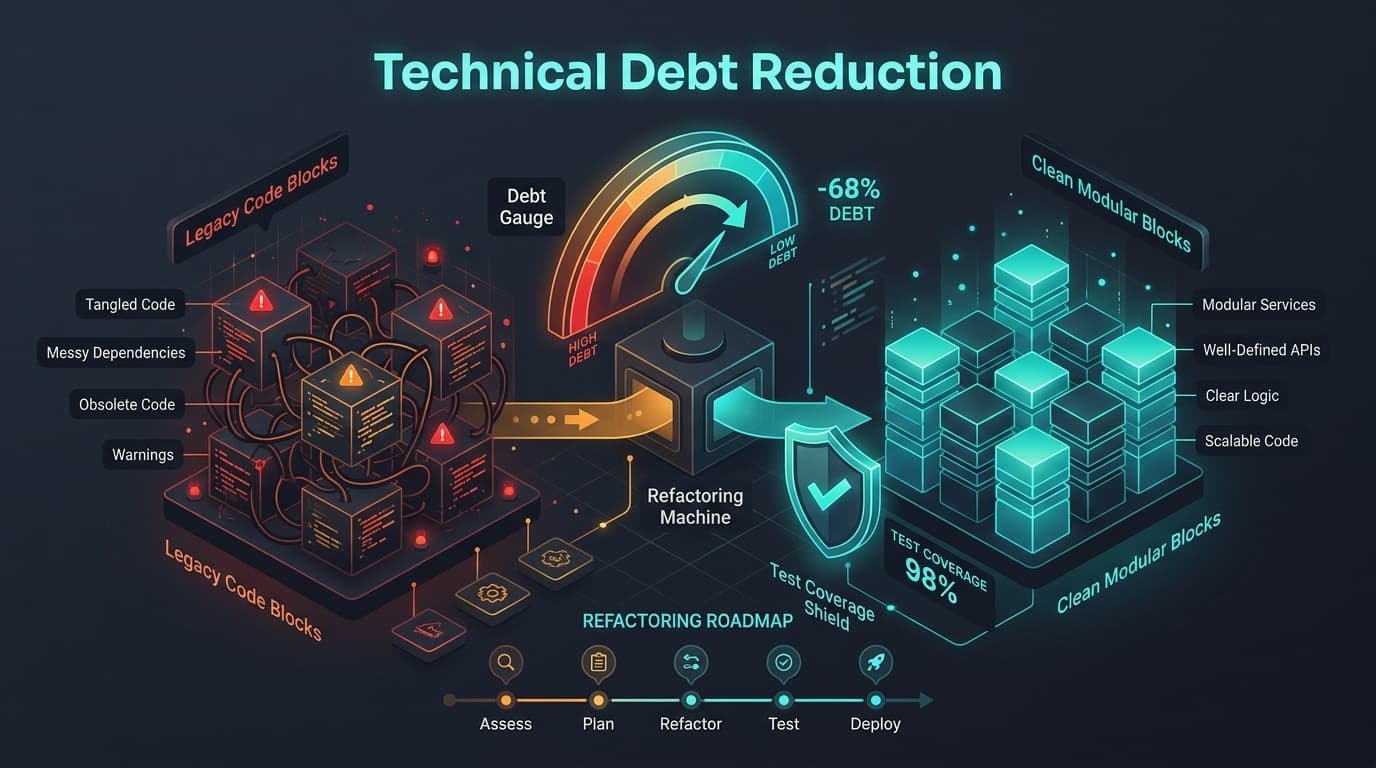
Every software product carries some technical debt — the future cost of shortcuts, outdated decisions and code that no longer fits the business. A little debt is healthy: it lets you ship faster and learn. Too much, and every new feature takes longer, bugs multiply and good engineers leave.
This guide explains how to recognise technical debt, measure it in terms the business understands, decide what to fix first, and reduce it steadily without freezing product development.
1. What Technical Debt Is
Technical debt works like financial debt. The "principal" is the work needed to fix a problem; the "interest" is the extra time you pay on every change until you do. Debt is only a problem when the interest becomes expensive.
| Type | Example |
|---|---|
| Code debt | Duplicated logic, huge files, unclear naming, no tests |
| Architecture debt | Tightly coupled modules, a database schema that no longer fits the domain |
| Dependency debt | Outdated frameworks, unsupported libraries, known security vulnerabilities |
| Infrastructure debt | Manual deployments, no staging environment, snowflake servers |
| Test debt | Low coverage on critical paths, flaky tests that everyone ignores |
| Documentation debt | Knowledge lives in one person's head |
2. Warning Signs Your Debt Is Too High
- Simple changes take days instead of hours, and estimates keep growing.
- Fixing one bug regularly creates another.
- Releases are stressful, infrequent or need a "deployment day".
- Engineers avoid certain parts of the codebase.
- Onboarding a new developer takes more than a few weeks.
- You are running framework versions that no longer receive security updates.
3. How to Measure Technical Debt
No single number captures debt, but these metrics together give a clear picture:
- DORA metrics: deployment frequency, lead time for changes, change failure rate and time to restore service. Rising lead time and failure rate are classic debt symptoms.
- Code hotspots: files that change often and are complex. Combining git history with complexity scores shows where debt actually costs you.
- Static analysis: tools like SonarQube or CodeClimate report duplication, complexity and maintainability ratings.
- Dependency health: number of outdated packages and open security advisories (
npm audit, Dependabot, Snyk). - Test coverage on critical paths — checkout, authentication, billing — rather than overall percentage.
- Developer survey: ask engineers which areas slow them down most. They usually know.
# Find hotspots: the files changed most often in the last year
git log --since="12 months ago" --name-only --pretty=format: \
  | grep -v '^$' | sort | uniq -c | sort -rn | head -20
4. Prioritise with an Impact vs Effort Matrix
Not all debt is worth paying down. Score each item on business impact (how much it slows delivery, risks outages or security) and effort to fix:
- High impact, low effort: fix now. Quick wins like upgrading a vulnerable package or adding tests to a fragile module.
- High impact, high effort: plan it. Break into milestones and schedule across sprints.
- Low impact, low effort: fix opportunistically when working nearby.
- Low impact, high effort: leave it. Stable code that rarely changes does not need rewriting, however ugly.
Security vulnerabilities and unsupported dependencies jump the queue regardless of the matrix.
5. A Practical Reduction Plan
- Make debt visible. Keep a debt register in your backlog with the business impact written in plain language.
- Reserve capacity. Allocate 15–25% of each sprint to debt reduction. Consistent small investment beats occasional "cleanup months".
- Add tests before refactoring. Characterisation tests lock in current behaviour so you can change structure safely.
- Follow the Boy Scout rule. Leave every file you touch slightly better than you found it.
- Automate the guardrails. CI with linting, type checks, tests and dependency scanning stops new debt entering.
- Refactor incrementally. Use the Strangler Fig pattern to replace legacy modules piece by piece behind stable interfaces — see our monolith vs microservices guide.
- Track and report. Share lead time and incident trends with leadership so the investment is visible.
6. Refactor or Rewrite?
Full rewrites are tempting and frequently fail: they take longer than planned, the old system keeps changing, and hidden business rules get lost. Prefer incremental refactoring unless:
- The technology is end-of-life and cannot be upgraded or secured.
- The product's core purpose has fundamentally changed.
- The codebase is small enough to rebuild in a few months with low risk.
Even then, migrate in phases and run old and new systems in parallel where possible.
7. Explaining Technical Debt to Non-Technical Stakeholders
Talk in outcomes, not code. Instead of "we need to refactor the order service", say: "Changes to checkout take three times longer than other areas and caused two outages last quarter. Two sprints of work will cut that time in half and reduce incident risk." Tie every debt item to speed, revenue, risk or cost.
Need an independent view of your codebase? ByteOperator's software audits identify the debt that matters most and give you a prioritised plan. We also handle platform migrations and ongoing support and maintenance. Request a code audit.
Related reading:
- How Much Does Custom Software Development Cost in 2026? A Complete Pricing Guide
- AI Agents for Business: How to Automate Operations in 2026 (With Real Use Cases)
- Headless Commerce vs Traditional Ecommerce: Which Architecture Is Right for Your Brand?
- Technical SEO Checklist for 2026: 30 Checks to Get Your Site Crawled, Indexed and Ranked
- How to Build a SaaS MVP in 2026: A Step-by-Step Guide from Idea to Launch
- Generative Engine Optimization (GEO): How to Get Your Brand Cited in AI Search
- Ecommerce Platform Migration: How to Replatform Without Losing SEO Rankings
- Custom Shopify App Development (2026): Architecture, Remix & GraphQL
- Enterprise AI Automation & Agentic Workflows: Architecture & Guardrails (2026)
- Full-Stack SaaS Architecture with Next.js App Router & PostgreSQL (2026)
- Shopify to Custom Platform Migration: Architecture & Execution (2026)
- Shopify Speed Optimization Guide 2026: Core Web Vitals, LCP & Performance Best Practices
- MERN Stack Web Development Guide 2026: MongoDB, Express, React & Node.js
- API Integration Best Practices 2026: REST, GraphQL, Webhooks & Third-Party Reliability
- eCommerce Conversion Rate Optimization (CRO) Guide 2026: Tactics, Testing & Checkout
- How to Measure ROI on AI Automation: A Business Guide for 2026
- Web3 & Blockchain Development Guide 2026: Smart Contracts, dApps & DeFi
- React Performance Optimization Guide 2026: Bundle Size, Rendering & React 19
- Multi-Tenant SaaS Architecture Guide 2026: Database Models, Isolation & Scaling
- eCommerce Email Marketing Strategy 2026: Automation Flows, Segmentation & Klaviyo
- Cloud Cost Optimization Guide 2026: AWS, GCP & Azure FinOps Strategies
- Enterprise RAG Architecture Guide 2026: Vector Search, Hybrid Retrieval & LLM Systems
- Event-Driven Architecture & Microservices: Kafka, RabbitMQ & Distributed Systems
- DevOps & CI/CD Pipeline Best Practices 2026: GitOps, Kubernetes & Zero-Downtime Releases
- Web Application Security & OWASP Top 10 Guide: Hardening Full-Stack Applications
- Headless CMS Architecture with Next.js 2026: Sanity, Strapi & Contentful Comparison
- GraphQL vs REST API Architecture: Performance, Scalability & Best Practices in 2026
- SQL vs NoSQL Database Selection: PostgreSQL, MongoDB, Redis & DynamoDB Comparison
- Enterprise Prompt Engineering & LLM Architecture: Production Techniques for 2026
- Monolithic vs Microservices Architecture in 2026: The Modular Monolith & Beyond
- Cross-Platform Mobile App Architecture: React Native vs Flutter vs Swift & Kotlin 2026
- Core Web Vitals in 2026: How to Fix INP, LCP & CLS (Step-by-Step Guide)
- How to Choose a Software Development Company: 12-Point Checklist for 2026
- How to Write a Software Requirements Document (SRS) — Free Template & Examples
- n8n vs Zapier vs Make (2026): Which Workflow Automation Tool Should You Use?
Frequently asked questions
Is technical debt always bad?
No. Deliberate, short-term debt can be a smart business decision — for example, launching an MVP quickly to validate demand. It becomes a problem when it is not tracked or repaid and the extra time spent on every change starts slowing the business down.
How much time should a team spend on technical debt?
Many healthy engineering teams reserve around 15 to 25 percent of each sprint for reducing technical debt and improving tooling. Teams with severe debt may temporarily invest more, but consistent, ongoing investment is more effective than occasional large clean-ups.
How do you measure technical debt?
Combine several signals: DORA metrics such as lead time and change failure rate, code hotspots from git history, static analysis maintainability scores, outdated or vulnerable dependencies, test coverage on critical paths, and regular developer feedback on which areas slow them down.
Should we rewrite our legacy application from scratch?
Usually not. Full rewrites carry high risk and often take far longer than expected. Incremental refactoring and the Strangler Fig pattern let you modernise piece by piece while continuing to ship features. A rewrite is justified mainly when the technology is end-of-life or the product has fundamentally changed.