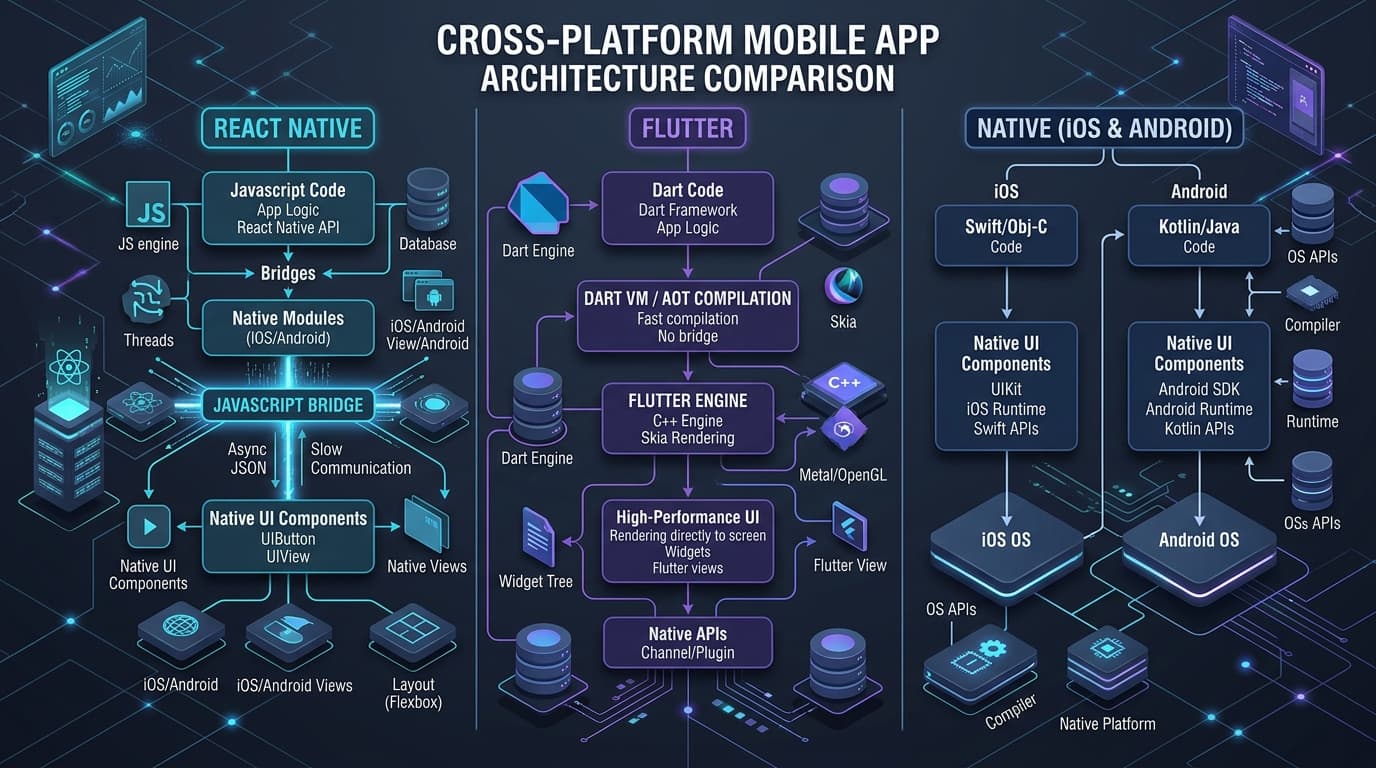
Delivering exceptional mobile experiences across iOS and Android is a critical requirement for modern software businesses. Historically, engineering leaders had to choose between high-cost dual-codebase native development (Swift/SwiftUI for iOS and Kotlin/Jetpack Compose for Android) or sluggish cross-platform web wrappers.
In 2026, cross-platform mobile frameworks have achieved near-native parity. With React Native's New Architecture (Fabric, TurboModules, Bridgeless mode) and Flutter's next-generation Impeller graphics engine, cross-platform development offers unmatched code reuse without compromising 120Hz smooth scrolling, gesture responsiveness, or device hardware access.
1. Architectural Comparison: React Native vs Flutter vs Native
The core differences emerge in how each framework compiles UI elements, interfaces with operating system APIs, and manages execution threads:
| Technical Dimension | React Native (New Architecture) | Flutter (Impeller Engine) | Native (Swift & Kotlin) |
|---|---|---|---|
| Primary Language | TypeScript / JavaScript (Hermes engine) | Dart (AOT compiled to native ARM machine code) | Swift (iOS) / Kotlin (Android) |
| UI Rendering Approach | Native OS UI Widgets via C++ JSI direct calls | Custom canvas rendering via Impeller engine (Metal/Vulkan) | Direct platform native frameworks (SwiftUI / Jetpack Compose) |
| Bridge / Interop Layer | Bridgeless (JavaScript Interface - C++ JSI) | Platform Channels (C++ binary interop) | Direct platform native execution (0 abstraction) |
| Code Reusability | 85% - 95% cross-platform + Web (React) | 90% - 98% cross-platform (iOS, Android, Web, Desktop) | 0% (Two completely separate codebases) |
| Ecosystem & Libraries | Massive NPM ecosystem, Expo tooling | Curated Pub.dev package ecosystem | Apple CocoaPods / SwiftPM & Google Maven |
| App Bundle Size | Medium (approx. 15–25 MB base) | Medium (approx. 15–30 MB base) | Minimal (approx. 5–12 MB base) |
2. React Native's New Architecture: Bridgeless & Fabric
Legacy React Native relied on an asynchronous JSON message bridge to serialize data between JavaScript and native Objective-C/Java threads, causing frame drops during rapid gesture scrolling. The New Architecture completely eliminates this bridge:
- JavaScript Interface (JSI): A lightweight C++ abstraction that exposes native C++ object references directly to the JavaScript runtime. JavaScript can invoke native platform methods synchronously with zero JSON serialization overhead.
- Fabric Renderer: A concurrent C++ rendering pipeline that computes UI layouts directly on background threads using the Yoga engine, drastically improving initialization time and list scrolling performance.
- TurboModules: Native modules are loaded lazily on demand rather than loading every hardware wrapper (Camera, Bluetooth, Location) at application launch.
- Hermes JavaScript Engine: A bytecode-optimized JavaScript engine tailored specifically for mobile, featuring fast ahead-of-time (AOT) bytecode compilation and aggressive garbage collection.
3. Flutter Architecture: The Impeller Graphics Engine
Unlike React Native which translates UI into native platform widgets, Flutter controls every pixel on screen directly. Flutter draws UI components onto a GPU canvas using its new Impeller rendering engine:
- Elimination of Shader Compilation Jank: Legacy graphics engines compiled GPU shaders at runtime during animations, causing noticeable first-frame stutter. Impeller pre-compiles all shaders ahead of time during the application build phase.
- Targeted GPU Backends: Direct execution over modern low-level graphics APIs—Apple Metal on iOS and Vulkan on Android.
- Pixel-Perfect Visual Consistency: Because Flutter does not map to OS widgets, your design system renders with 100% mathematical identicality across every Android device, OS version, and iOS model.
4. Offline-First Mobile Architecture & Data Synchronization
Mobile networks are inherently unreliable. Enterprise mobile architectures must be designed offline-first rather than treating offline support as an afterthought:
// Offline-First Sync Architecture Pattern
Client Action (e.g. Add to Cart / Update Profile)
  ├── 1. Optimistically write to local encrypted database (WatermelonDB / PowerSync / SQLite)
  ├── 2. UI updates immediately (0ms perceived latency)
  ├── 3. Enqueue mutation in persistent Outbox Table
  └── 4. Background Sync Service detects network connectivity
        ├── Replays mutations to backend GraphQL / REST API in sequential order
        └── Handles conflict resolution (Last-Write-Wins or Vector Clocks)
5. How to Select the Right Framework for Your Mobile App
Use this strategic matrix to choose your mobile tech stack in 2026:
- Choose React Native (with Expo) when: Your team already has deep React / TypeScript expertise, you want to share business logic between web and mobile platforms, or your application relies heavily on native mobile ecosystem integrations.
- Choose Flutter when: You are building high-complexity custom UI animations, custom gaming/fintech dashboards requiring pixel perfection, or targeting multi-screen platforms (Mobile, Desktop, and Embedded displays).
- Choose Pure Native (Swift & Kotlin) when: You are building computationally intensive augmented reality (ARKit/ARCore), low-level audio/video editing suites, heavy Bluetooth hardware accessories, or OS-native AI integrations (CoreML on Apple Silicon).
Building a high-performance mobile application or modernizing an existing app codebase? Explore ByteOperator's mobile app development services, our custom software solutions, or consult with our lead mobile architects.
Related reading:
- How Much Does Custom Software Development Cost in 2026? A Complete Pricing Guide
- AI Agents for Business: How to Automate Operations in 2026 (With Real Use Cases)
- Headless Commerce vs Traditional Ecommerce: Which Architecture Is Right for Your Brand?
- Technical SEO Checklist for 2026: 30 Checks to Get Your Site Crawled, Indexed and Ranked
- How to Build a SaaS MVP in 2026: A Step-by-Step Guide from Idea to Launch
- Generative Engine Optimization (GEO): How to Get Your Brand Cited in AI Search
- Ecommerce Platform Migration: How to Replatform Without Losing SEO Rankings
- Custom Shopify App Development (2026): Architecture, Remix & GraphQL
- Enterprise AI Automation & Agentic Workflows: Architecture & Guardrails (2026)
- Full-Stack SaaS Architecture with Next.js App Router & PostgreSQL (2026)
- Shopify to Custom Platform Migration: Architecture & Execution (2026)
- Shopify Speed Optimization Guide 2026: Core Web Vitals, LCP & Performance Best Practices
- MERN Stack Web Development Guide 2026: MongoDB, Express, React & Node.js
- API Integration Best Practices 2026: REST, GraphQL, Webhooks & Third-Party Reliability
- eCommerce Conversion Rate Optimization (CRO) Guide 2026: Tactics, Testing & Checkout
- How to Measure ROI on AI Automation: A Business Guide for 2026
- Web3 & Blockchain Development Guide 2026: Smart Contracts, dApps & DeFi
- React Performance Optimization Guide 2026: Bundle Size, Rendering & React 19
- Multi-Tenant SaaS Architecture Guide 2026: Database Models, Isolation & Scaling
- eCommerce Email Marketing Strategy 2026: Automation Flows, Segmentation & Klaviyo
- Cloud Cost Optimization Guide 2026: AWS, GCP & Azure FinOps Strategies
- Enterprise RAG Architecture Guide 2026: Vector Search, Hybrid Retrieval & LLM Systems
- Event-Driven Architecture & Microservices: Kafka, RabbitMQ & Distributed Systems
- DevOps & CI/CD Pipeline Best Practices 2026: GitOps, Kubernetes & Zero-Downtime Releases
- Web Application Security & OWASP Top 10 Guide: Hardening Full-Stack Applications
- Headless CMS Architecture with Next.js 2026: Sanity, Strapi & Contentful Comparison
- GraphQL vs REST API Architecture: Performance, Scalability & Best Practices in 2026
- SQL vs NoSQL Database Selection: PostgreSQL, MongoDB, Redis & DynamoDB Comparison
- Enterprise Prompt Engineering & LLM Architecture: Production Techniques for 2026
- Monolithic vs Microservices Architecture in 2026: The Modular Monolith & Beyond
Frequently asked questions
What is the main advantage of React Native New Architecture?
The React Native New Architecture replaces the legacy asynchronous JSON bridge with the C++ JavaScript Interface (JSI), Fabric renderer, and TurboModules. This allows direct, synchronous in-memory communication between JavaScript and native platform threads, eliminating frame drops and UI stutter during complex animations.
How does Flutter Impeller solve shader compilation jank?
Flutter Impeller pre-compiles all GPU shaders ahead of time (AOT) during the app build process rather than compiling them dynamically at runtime. This guarantees consistent 60fps and 120fps animations without the first-run stutter that affected earlier Skia-based rendering.
Can cross-platform mobile apps access device hardware like camera and Bluetooth?
Yes. Both React Native and Flutter have mature plugin ecosystems that provide complete access to cameras, GPS location, Bluetooth Low Energy (BLE), biometrics (FaceID/TouchID), accelerometer sensors, and background push notifications with native execution speed.
What is an offline-first mobile app architecture?
An offline-first architecture stores and reads all application state from a local on-device database (like SQLite, WatermelonDB, or Realm) first. When network connectivity is established, a background synchronization worker handles bidirectional syncing, queued outbox mutations, and conflict resolution with cloud backends.