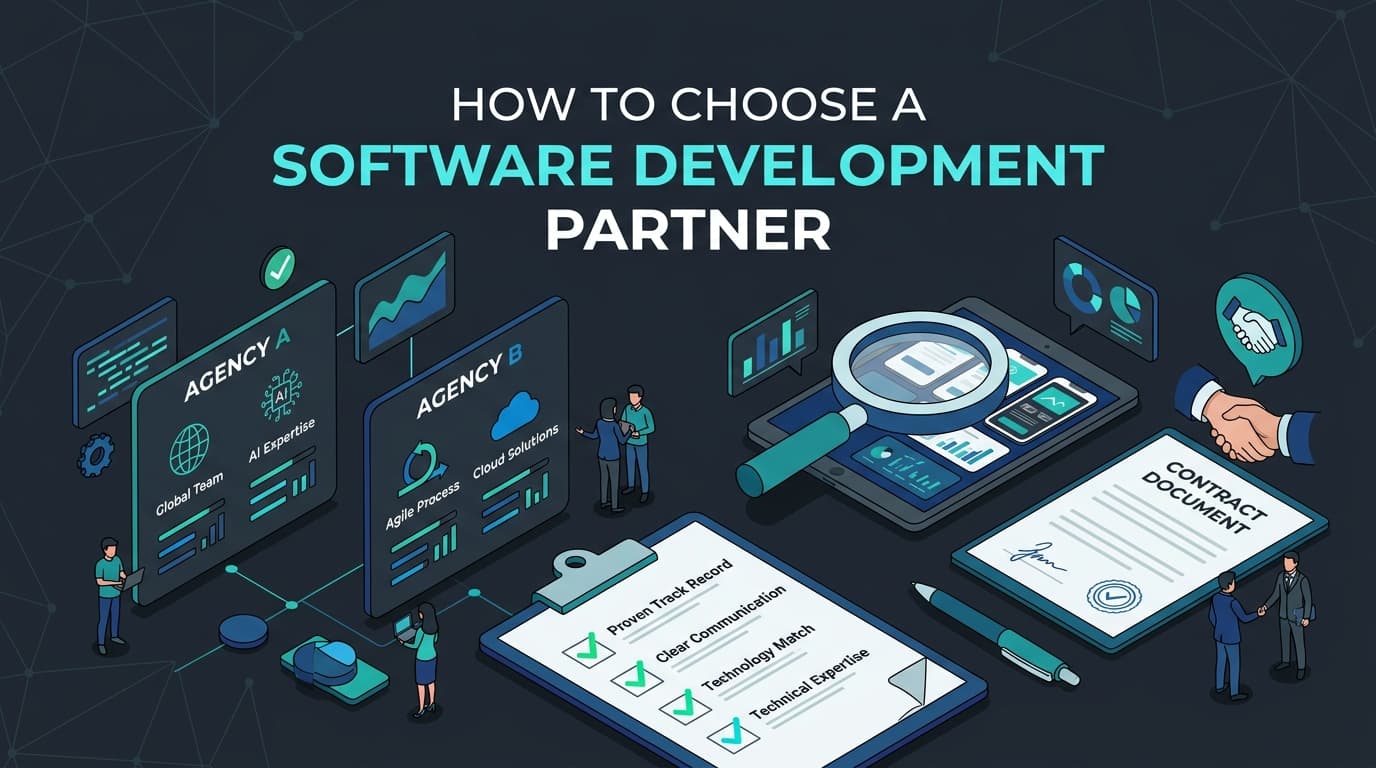
Picking a software development company is one of the highest-stakes decisions a business makes. The right partner ships a product that grows with you. The wrong one leaves you with missed deadlines, an unmaintainable codebase and a budget spent twice.
This guide gives you a repeatable process: what to prepare before you contact anyone, a 12-point evaluation checklist, the questions that reveal how an agency really works, and the red flags that should end a conversation.
1. Before You Contact Anyone: Prepare These 5 Things
- The business problem. Describe the outcome, not just features — "reduce manual order processing from 6 hours a day to under 1".
- Core users and their top tasks. Who uses the product and what must they be able to do on day one?
- A realistic budget range. Sharing a range saves weeks; good partners will tell you what is achievable within it.
- Timeline drivers. Is there a fixed launch date (an event, funding round, contract) or is it flexible?
- Constraints. Existing systems to integrate with, compliance needs (GDPR, HIPAA, SOC 2) and preferred technologies.
A short brief or software requirements document makes proposals comparable and far more accurate.
2. The 12-Point Evaluation Checklist
| # | Criterion | What good looks like |
|---|---|---|
| 1 | Relevant portfolio | Live products similar in complexity to yours, not just attractive screenshots |
| 2 | Verifiable references | Two or three past clients you can actually speak with |
| 3 | Discovery process | They ask hard questions about your users and goals before quoting |
| 4 | Technical depth | Clear reasoning for stack choices, architecture and scalability |
| 5 | Product thinking | They challenge scope and suggest a leaner first release |
| 6 | Communication | Named point of contact, weekly demos, shared project board, overlapping hours |
| 7 | Quality assurance | Automated tests, code reviews, staging environments, QA as part of each sprint |
| 8 | Security practices | Least-privilege access, secrets management, dependency scanning, OWASP awareness |
| 9 | Transparent pricing | Itemised estimates with assumptions and what is out of scope |
| 10 | IP and code ownership | You own the code and repositories from day one |
| 11 | Post-launch support | Defined maintenance plans, SLAs and handover documentation |
| 12 | Cultural fit | They are honest about trade-offs and comfortable saying "no" |
3. Questions to Ask on the Discovery Call
- "Can you walk me through a project that went wrong, and what you changed afterwards?"
- "Who exactly will work on my project, and what is their seniority? Will that change?"
- "How do you handle scope changes mid-project?"
- "What does a typical week look like for me as the client?"
- "How do you test code before it reaches production?"
- "If we part ways, what do I receive — repositories, documentation, credentials, infrastructure?"
- "What would you cut from our brief to launch faster?"
The answers matter less than how they answer. Specific, honest responses with real examples beat polished sales language every time.
4. Pricing Models Explained
| Model | How it works | Best for | Watch out for |
|---|---|---|---|
| Fixed price | One agreed price for a defined scope | Small, well-specified projects | Padded quotes, change-request fees, rigid scope |
| Time & materials | Pay for hours or days actually worked | Evolving products and MVPs | Needs good reporting and budget caps |
| Dedicated team | Monthly fee for an allocated team | Long-term product development | Ensure team stability and clear goals |
| Phased / milestone | Paid discovery, then fixed-price phases | Most mid-size projects | Define acceptance criteria per milestone |
For realistic budget numbers, see our custom software development cost guide.
5. Red Flags That Should End the Conversation
- A detailed fixed quote after a single 20-minute call.
- The lowest price by a wide margin, with no explanation.
- Reluctance to put you in touch with past clients.
- They want to host the code in their own accounts and keep ownership.
- No mention of testing, code review or documentation.
- Senior people on the sales call who will never touch your project.
- They agree with everything and never push back.
6. Score Agencies Objectively
Give each criterion a weight, score shortlisted companies from 1 to 5, and multiply. A simple weighting that works for most projects:
- Relevant experience & references — 25%
- Technical and product quality — 25%
- Communication & process — 20%
- Price and commercial terms — 20%
- Support, ownership and fit — 10%
Finally, consider a small paid discovery phase (typically 1–3 weeks) before committing to the full build. It is the cheapest way to test the working relationship and leaves you with a clear plan either way.
7. Contract Essentials
- Full IP assignment to you on payment.
- Repositories, cloud accounts and domains registered in your name.
- Clear acceptance criteria and a warranty period for bugs after launch.
- Confidentiality (NDA) and data-protection terms.
- A fair termination clause with handover obligations.
Looking for a development partner that ticks every box? See how ByteOperator works on our case studies, explore our dedicated software developers and MVP development service, or book a free discovery call.
Related reading:
- How Much Does Custom Software Development Cost in 2026? A Complete Pricing Guide
- AI Agents for Business: How to Automate Operations in 2026 (With Real Use Cases)
- Headless Commerce vs Traditional Ecommerce: Which Architecture Is Right for Your Brand?
- Technical SEO Checklist for 2026: 30 Checks to Get Your Site Crawled, Indexed and Ranked
- How to Build a SaaS MVP in 2026: A Step-by-Step Guide from Idea to Launch
- Generative Engine Optimization (GEO): How to Get Your Brand Cited in AI Search
- Ecommerce Platform Migration: How to Replatform Without Losing SEO Rankings
- Custom Shopify App Development (2026): Architecture, Remix & GraphQL
- Enterprise AI Automation & Agentic Workflows: Architecture & Guardrails (2026)
- Full-Stack SaaS Architecture with Next.js App Router & PostgreSQL (2026)
- Shopify to Custom Platform Migration: Architecture & Execution (2026)
- Shopify Speed Optimization Guide 2026: Core Web Vitals, LCP & Performance Best Practices
- MERN Stack Web Development Guide 2026: MongoDB, Express, React & Node.js
- API Integration Best Practices 2026: REST, GraphQL, Webhooks & Third-Party Reliability
- eCommerce Conversion Rate Optimization (CRO) Guide 2026: Tactics, Testing & Checkout
- How to Measure ROI on AI Automation: A Business Guide for 2026
- Web3 & Blockchain Development Guide 2026: Smart Contracts, dApps & DeFi
- React Performance Optimization Guide 2026: Bundle Size, Rendering & React 19
- Multi-Tenant SaaS Architecture Guide 2026: Database Models, Isolation & Scaling
- eCommerce Email Marketing Strategy 2026: Automation Flows, Segmentation & Klaviyo
- Cloud Cost Optimization Guide 2026: AWS, GCP & Azure FinOps Strategies
- Enterprise RAG Architecture Guide 2026: Vector Search, Hybrid Retrieval & LLM Systems
- Event-Driven Architecture & Microservices: Kafka, RabbitMQ & Distributed Systems
- DevOps & CI/CD Pipeline Best Practices 2026: GitOps, Kubernetes & Zero-Downtime Releases
- Web Application Security & OWASP Top 10 Guide: Hardening Full-Stack Applications
- Headless CMS Architecture with Next.js 2026: Sanity, Strapi & Contentful Comparison
- GraphQL vs REST API Architecture: Performance, Scalability & Best Practices in 2026
- SQL vs NoSQL Database Selection: PostgreSQL, MongoDB, Redis & DynamoDB Comparison
- Enterprise Prompt Engineering & LLM Architecture: Production Techniques for 2026
- Monolithic vs Microservices Architecture in 2026: The Modular Monolith & Beyond
- Cross-Platform Mobile App Architecture: React Native vs Flutter vs Swift & Kotlin 2026
- Core Web Vitals in 2026: How to Fix INP, LCP & CLS (Step-by-Step Guide)
- How to Write a Software Requirements Document (SRS) — Free Template & Examples
- n8n vs Zapier vs Make (2026): Which Workflow Automation Tool Should You Use?
- Technical Debt: How to Measure, Prioritise and Reduce It (Practical Guide)
Frequently asked questions
How do I know if a software development company is reliable?
Check live products in their portfolio, speak directly with two or three past clients, review how detailed and honest their proposal is, and look for clear processes around testing, communication and code ownership. A small paid discovery phase is the most reliable way to test the relationship before a large commitment.
Should I choose a fixed-price or time-and-materials contract?
Fixed price works best for small projects with a stable, detailed scope. Time and materials suits products that will evolve, such as MVPs, because you can change priorities without renegotiating. Many teams use a hybrid: a paid discovery phase followed by fixed-price milestones.
Who should own the source code when I hire an agency?
You should. Your contract should assign full intellectual property to you, and code repositories, cloud accounts and domains should be created in your organisation’s name from the start so you can switch providers at any time.
How many software companies should I compare?
Shortlist three to five companies. Fewer makes comparison difficult, while more takes significant time and rarely improves the outcome. Send each the same brief so their proposals are directly comparable.