For over a decade, the enterprise software industry was swept by a dogma that microservices were the universal standard for modern web architecture. However, many organizations that prematurely adopted microservices experienced crippling operational complexity, distributed transaction failures, ballooning cloud infrastructure bills, and degraded developer velocity.
In 2026, pragmatic software engineering embraces a nuanced, lifecycle-driven approach. The rise of the Modular Monolith, serverless compute, and container orchestration has clarified exactly when microservices provide true leverage—and when they become an expensive anti-pattern.
1. Defining the Paradigms: Monolith vs Microservices
The core distinction lies in deployment boundaries, data ownership, and runtime isolation:
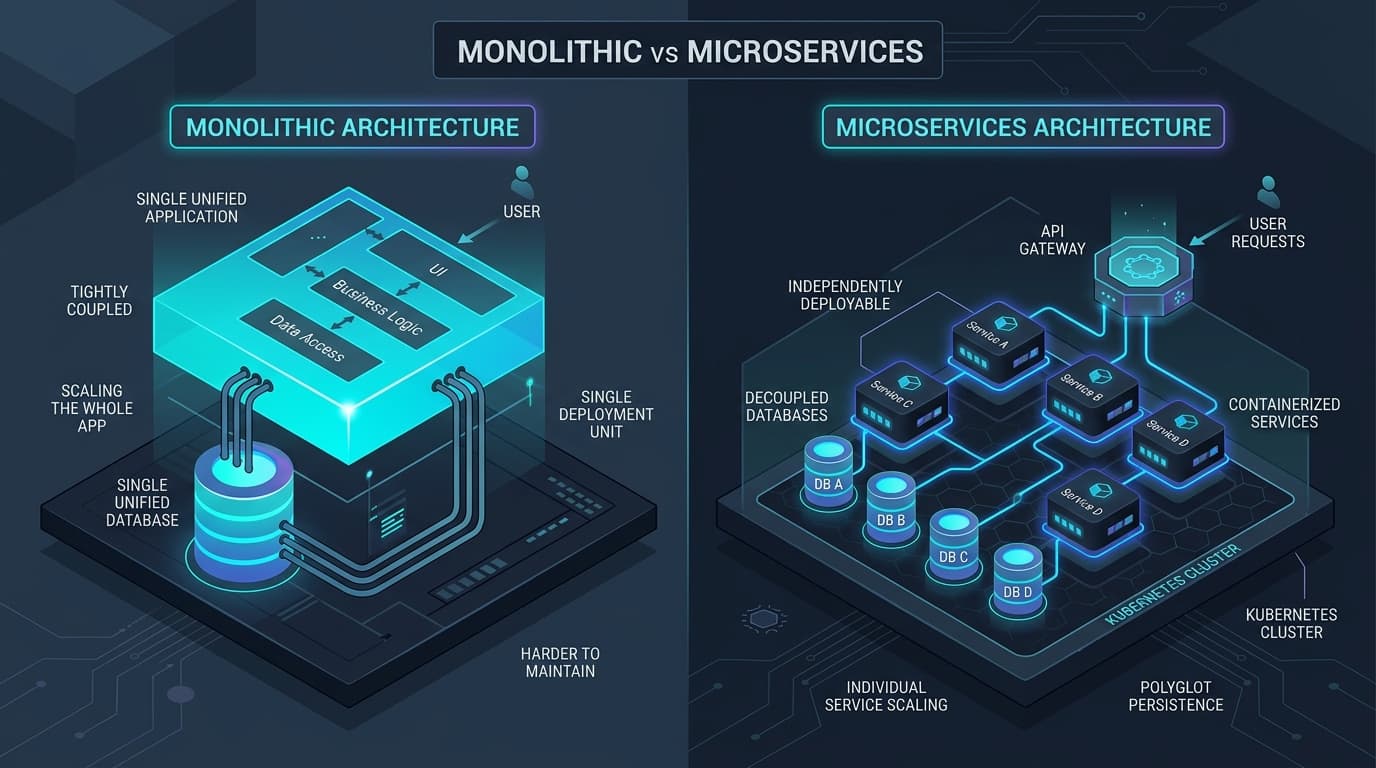
- Monolithic Architecture: All business domains (auth, billing, inventory, notifications) reside within a single codebase, compile into a single deployment artifact, and typically share a centralized relational database. Scaling involves replicating the entire application container across multiple virtual instances.
- Microservices Architecture: The application is decomposed into independently deployable, loosely coupled services organized around specific Bounded Contexts (Domain-Driven Design). Each service owns its private data store and communicates via network protocols (gRPC, REST, or Kafka message brokers).
| Architecture Dimension | Traditional Monolith | Modular Monolith | Microservices |
|---|---|---|---|
| Deployment Unit | Single unified binary / container | Single unified binary / container | Dozens to hundreds of discrete services |
| Database Strategy | Single shared database | Single database with strict schema isolation | Database-per-service (Polyglot persistence) |
| Communication Latency | Sub-microsecond in-memory method calls | Sub-microsecond in-memory method calls | Millisecond network calls (HTTP/gRPC/Kafka) |
| Operational Overhead | Low (single CI/CD pipeline) | Low to medium | High (Service mesh, distributed tracing, K8s) |
| Organizational Fit | Small to medium teams (<25 engineers) | Teams of 20 to 100+ engineers | Multiple autonomous engineering squads (100+) |
| Distributed Complexity | None; ACID transactions across tables | None; strict module boundaries enforced in code | High; eventual consistency, Saga patterns, 2PC |
2. The True Costs of Microservices
While microservices enable massive organizations (like Netflix, Amazon, and Uber) to deploy thousands of daily updates without team locks, they introduce severe architectural challenges:
- Network Latency & Failure Cascades: Replacing in-memory function execution with network hops adds serialization overhead and requires circuit breakers, retries with exponential backoff, and fallback states.
- Data Consistency & Saga Patterns: In a database-per-service model, executing a distributed transaction (e.g., reserving inventory while charging a credit card) requires complex Saga orchestration or choreography to handle compensating rollbacks if one step fails.
- Observability & Distributed Tracing: Debugging a single user request requires distributed tracing tools (OpenTelemetry, Jaeger) to correlate log spans across 15+ services.
- DevOps Infrastructure Overhead: Managing Kubernetes clusters, Helm charts, API Gateways, service meshes (Istio), and secret rotation requires dedicated platform engineering teams.
3. The Rise of the Modular Monolith
The Modular Monolith provides the structural discipline of microservices without the distributed networking tax. Code is organized into strictly isolated domain modules with public API interfaces, enforced at compile time using tools like Nx, Turborepo, or ArchUnit:
// Modular Monolith Directory Structure
src/
  modules/
    billing/
      public-api.ts   // Only exported interface allowed to be imported by other modules
      internal/       // Hidden private implementation logic, services & repos
    orders/
      public-api.ts
      internal/
    inventory/
      public-api.ts
      internal/
If the Orders module needs to check product stock, it calls inventoryService.checkStock() via an in-memory interface rather than making a slow network request over HTTP. If a single module later outgrows the monolith in compute or throughput requirements, its clean boundary allows it to be extracted into a standalone microservice in hours rather than months.
4. Architectural Migration: The Strangler Fig Pattern
When migrating an existing legacy monolith to microservices, never attempt a "Big Bang" rewrite. Deploy the Strangler Fig Pattern:
- Place an API Gateway (Kong, Envoy, Cloudflare Workers) in front of the legacy monolith.
- Identify a high-value, decoupled domain (e.g., Image Processing, Notification Dispatch, Search Indexing).
- Build and deploy the new microservice independently.
- Configure the API Gateway to route specific traffic paths (e.g.,
/api/notifications/*) to the new microservice while routing all other requests to the monolith. - Iterate domain by domain until the legacy monolith is systematically replaced.
5. Pragmatic Decision Framework
Select your architecture based on organizational maturity and traffic demands:
- Start with a Modular Monolith: If you are launching an early-stage product, a startup MVP, or scaling a team of fewer than 50 engineers. Focus engineering cycles on business logic and customer features.
- Adopt Microservices when: Distinct business domains require independent scaling (e.g., video transcoding vs user auth), different programming runtimes are mathematically required (Python for ML vs Go for web), or multiple autonomous squads need independent release cycles without deployment contention.
Planning a modern platform architecture or refactoring a legacy codebase? Discover ByteOperator's software development services, our platform migration capabilities, or consult with our enterprise systems architects.
Related reading:
- How Much Does Custom Software Development Cost in 2026? A Complete Pricing Guide
- AI Agents for Business: How to Automate Operations in 2026 (With Real Use Cases)
- Headless Commerce vs Traditional Ecommerce: Which Architecture Is Right for Your Brand?
- Technical SEO Checklist for 2026: 30 Checks to Get Your Site Crawled, Indexed and Ranked
- How to Build a SaaS MVP in 2026: A Step-by-Step Guide from Idea to Launch
- Generative Engine Optimization (GEO): How to Get Your Brand Cited in AI Search
- Ecommerce Platform Migration: How to Replatform Without Losing SEO Rankings
- Custom Shopify App Development (2026): Architecture, Remix & GraphQL
- Enterprise AI Automation & Agentic Workflows: Architecture & Guardrails (2026)
- Full-Stack SaaS Architecture with Next.js App Router & PostgreSQL (2026)
- Shopify to Custom Platform Migration: Architecture & Execution (2026)
- Shopify Speed Optimization Guide 2026: Core Web Vitals, LCP & Performance Best Practices
- MERN Stack Web Development Guide 2026: MongoDB, Express, React & Node.js
- API Integration Best Practices 2026: REST, GraphQL, Webhooks & Third-Party Reliability
- eCommerce Conversion Rate Optimization (CRO) Guide 2026: Tactics, Testing & Checkout
- How to Measure ROI on AI Automation: A Business Guide for 2026
- Web3 & Blockchain Development Guide 2026: Smart Contracts, dApps & DeFi
- React Performance Optimization Guide 2026: Bundle Size, Rendering & React 19
- Multi-Tenant SaaS Architecture Guide 2026: Database Models, Isolation & Scaling
- eCommerce Email Marketing Strategy 2026: Automation Flows, Segmentation & Klaviyo
- Cloud Cost Optimization Guide 2026: AWS, GCP & Azure FinOps Strategies
- Enterprise RAG Architecture Guide 2026: Vector Search, Hybrid Retrieval & LLM Systems
- Event-Driven Architecture & Microservices: Kafka, RabbitMQ & Distributed Systems
- DevOps & CI/CD Pipeline Best Practices 2026: GitOps, Kubernetes & Zero-Downtime Releases
- Web Application Security & OWASP Top 10 Guide: Hardening Full-Stack Applications
- Headless CMS Architecture with Next.js 2026: Sanity, Strapi & Contentful Comparison
- GraphQL vs REST API Architecture: Performance, Scalability & Best Practices in 2026
- SQL vs NoSQL Database Selection: PostgreSQL, MongoDB, Redis & DynamoDB Comparison
- Enterprise Prompt Engineering & LLM Architecture: Production Techniques for 2026
- Cross-Platform Mobile App Architecture: React Native vs Flutter vs Swift & Kotlin 2026
Frequently asked questions
What is a Modular Monolith?
A Modular Monolith is an architectural approach where an entire system runs as a single deployment artifact and shares a database, but the internal codebase is strictly partitioned into independent, decoupled domain modules with explicit public interfaces. It offers the architectural hygiene of microservices without the networking, latency, and distributed operational overhead.
What is the Strangler Fig Pattern in software architecture?
The Strangler Fig Pattern is an incremental migration strategy where legacy system features are gradually replaced by new microservices behind an API Gateway router. As new services are built, traffic is rerouted domain by domain until the old monolithic system can be safely decommissioned without downtime.
How do microservices handle distributed data consistency?
Because each microservice maintains its own private database, distributed consistency is achieved using Eventual Consistency and the Saga Pattern (orchestration or choreography). Instead of traditional two-phase commit (2PC) database locks, services emit domain events and execute compensating transactions if downstream steps fail.
Should early-stage startups build microservices?
In almost all cases, no. Early-stage startups undergo rapid product iteration and schema changes. Microservices add distributed network overhead, complex CI/CD pipelines, and multi-repo maintenance that slow down engineering velocity when finding product-market fit. A well-structured monolithic architecture is the ideal starting point.