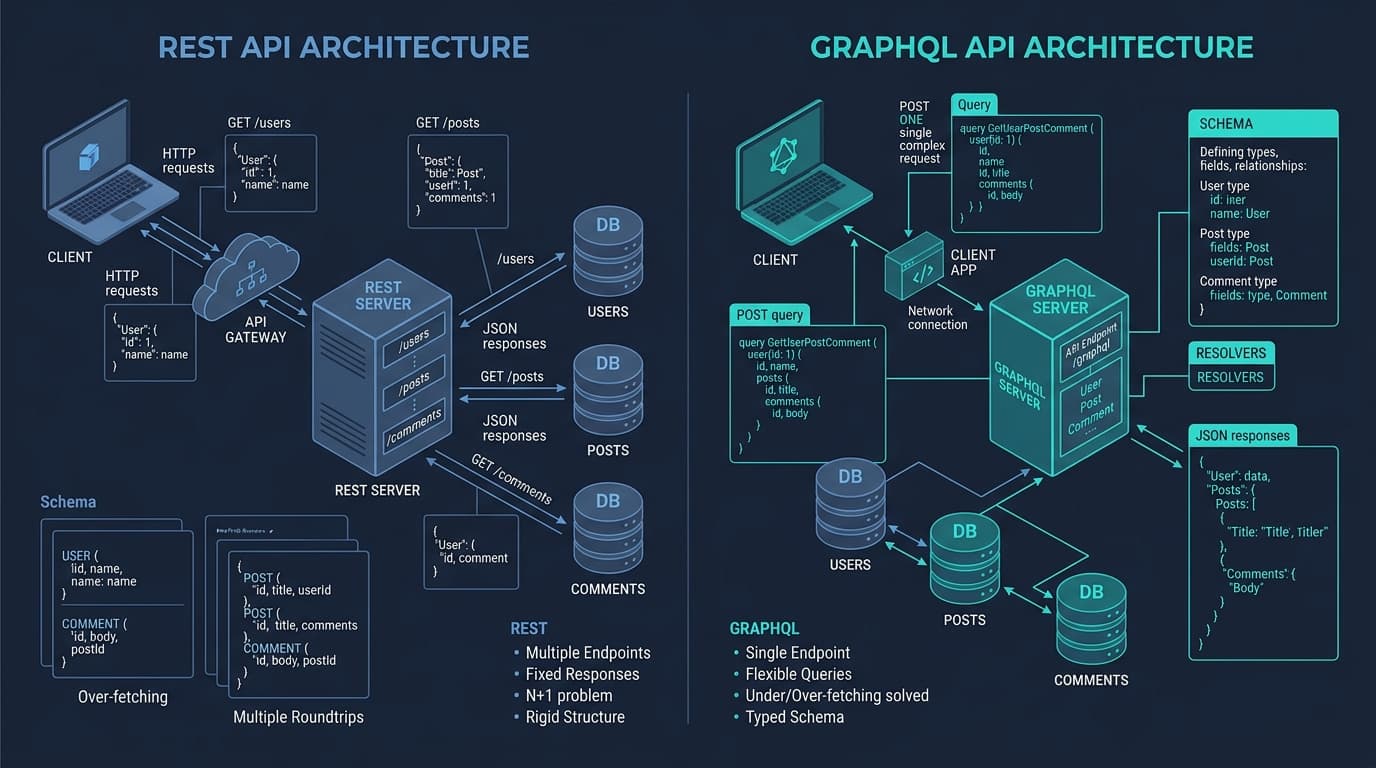
Modern distributed applications rely heavily on robust Application Programming Interfaces (APIs) to exchange data between frontend clients, microservices, and third-party ecosystems. Choosing between REST (Representational State Transfer) and GraphQL is one of the most critical architectural decisions engineering teams face.
While REST has served as the backbone of web communication for over two decades, GraphQL emerged to address the challenges of mobile networks, complex nested data graphs, and multi-platform client requirements. This technical guide breaks down the core architectural differences, trade-offs, caching paradigms, and implementation strategies for 2026.
1. Core Architectural Differences: Endpoints vs Graph Schemas
The foundational distinction lies in how data is modeled, requested, and delivered across the wire:
- REST Architecture: Entity-driven and resource-oriented. Each resource is accessed via distinct HTTP endpoints (e.g.,
GET /api/v1/users/123,GET /api/v1/users/123/orders). Responses deliver a fixed JSON payload determined entirely by the backend server. - GraphQL Architecture: Client-driven and schema-oriented. The client communicates with a single POST endpoint (typically
/graphql), sending a declarative query that specifies the precise fields and nested relations required. The server executes field resolvers and returns a payload mirroring the query structure exactly.
| Feature / Dimension | REST API | GraphQL |
|---|---|---|
| Endpoint Structure | Multiple discrete URIs for each resource | Single unified endpoint (POST /graphql) |
| Data Fetching | Fixed payloads; often causes over/under-fetching | Precise client-defined queries; zero over-fetching |
| Network Efficiency | Multiple roundtrips required for nested relations | Single roundtrip retrieves all deeply nested data |
| Caching Mechanism | Native HTTP status codes, ETags & CDN edge caching | Application-level normalized caching (Apollo Client/Urql) |
| Type Safety & Contracts | OpenAPI / Swagger specs (often desynced) | Strongly typed Schema Definition Language (SDL) |
| File Uploads & Binary | Native multipart/form-data support | Requires multipart specs or separate S3 presigned URLs |
2. Eliminating Over-Fetching and Under-Fetching
In high-traffic mobile applications, payload size and latency directly impact conversion rates and battery life:
A. The Over-Fetching Bottleneck in REST
Suppose your mobile profile view only needs a user's name and avatar. Calling GET /api/users/42 often returns 40+ fields (addresses, billing tokens, creation dates, internal telemetry flags), consuming unnecessary mobile bandwidth.
B. The Under-Fetching (N+1 Request) Problem in REST
If you need to display a user's latest 5 orders and each order's product details, REST requires:
GET /api/users/42(1 request)GET /api/users/42/orders(1 request)GET /api/products/:idfor each item in the order (N requests)
With GraphQL, this entire hierarchical tree is resolved in a single HTTP POST roundtrip:
query GetUserDashboard($userId: ID!) {
  user(id: $userId) {
    id
    name
    avatarUrl
    orders(limit: 5) {
      id
      createdAt
      totalAmount
      items {
        product {
          title
          price
          sku
        }
      }
    }
  }
}
3. Solving the GraphQL Backend N+1 Query Problem: DataLoader Pattern
While GraphQL eliminates network roundtrips for the client, naive server-side resolver execution can trigger database N+1 queries. If resolving 10 orders each executes a separate SQL query for the product record, your database will be overloaded.
The standard solution is using DataLoader to batch and memoize database calls within a single execution tick:
import DataLoader from 'dataloader';
import { db } from '@/lib/database';

// Batches 50 individual product lookups into a single SQL "WHERE id IN (...)"
export const productLoader = new DataLoader(async (productIds: readonly string[]) => {
  const products = await db.products.findMany({
    where: { id: { in: [...productIds] } },
  });

  const productMap = new Map(products.map((p) => [p.id, p]));
  return productIds.map((id) => productMap.get(id) || null);
});
4. Caching: HTTP Edge Caching vs Normalized Client Caches
Caching is where REST maintains a major architectural advantage:
- REST HTTP Caching: Because REST uses standard HTTP verbs (
GET) and unique URIs, intermediate proxies, browsers, and CDNs (Cloudflare, Fastly) can cache responses transparently usingCache-Control: public, max-age=3600andETagheaders. - GraphQL Edge Caching: Because all queries hit the same endpoint via HTTP
POST, CDNs cannot cache responses out of the box. Modern architectures address this using Persisted Queries (APQ), converting verified queries into deterministicGETrequests with SHA-256 hashes that CDNs can cache effortlessly.
5. Security Considerations: Rate Limiting & Query Complexity
In REST APIs, rate limiting is straightforward: throttle by IP or API token to 100 requests per minute per route. In GraphQL, a malicious actor could send a deeply nested recursive query (e.g., author -> posts -> author -> posts...) that consumes 100% of server CPU in a single request.
Enterprise GraphQL implementations protect backends using:
- Query Depth Limiting: Rejects any query nested deeper than 5-7 levels.
- Static Query Complexity Analysis: Assigns computational point weights to fields and blocks queries exceeding a complexity budget (e.g., 1000 points).
- Persisted Query Whitelisting: In production, disables arbitrary ad-hoc GraphQL queries entirely, only accepting registered query hashes generated during the frontend build step.
6. When to Choose REST vs GraphQL in 2026
Follow this decision framework when planning your API stack:
- Choose GraphQL when: You are building multi-client platforms (Web, iOS, Android, Smart TVs) with shared backends, fast-evolving UI requirements, complex relational entities, or microservice aggregation layers (GraphQL Federation / Subgraphs).
- Choose REST when: You are building public developer APIs, heavy binary/file-streaming services, simple CRUD microservices, or architectures that depend entirely on turnkey edge CDN caching without specialized tooling.
Need expert architecture for your cloud backends, API gateways, or Next.js applications? Discover ByteOperator's custom software development services, our cloud infrastructure solutions, or speak with our lead API engineers.
Related reading:
- How Much Does Custom Software Development Cost in 2026? A Complete Pricing Guide
- AI Agents for Business: How to Automate Operations in 2026 (With Real Use Cases)
- Headless Commerce vs Traditional Ecommerce: Which Architecture Is Right for Your Brand?
- Technical SEO Checklist for 2026: 30 Checks to Get Your Site Crawled, Indexed and Ranked
- How to Build a SaaS MVP in 2026: A Step-by-Step Guide from Idea to Launch
- Generative Engine Optimization (GEO): How to Get Your Brand Cited in AI Search
- Ecommerce Platform Migration: How to Replatform Without Losing SEO Rankings
- Custom Shopify App Development (2026): Architecture, Remix & GraphQL
- Enterprise AI Automation & Agentic Workflows: Architecture & Guardrails (2026)
- Full-Stack SaaS Architecture with Next.js App Router & PostgreSQL (2026)
- Shopify to Custom Platform Migration: Architecture & Execution (2026)
- Shopify Speed Optimization Guide 2026: Core Web Vitals, LCP & Performance Best Practices
- MERN Stack Web Development Guide 2026: MongoDB, Express, React & Node.js
- API Integration Best Practices 2026: REST, GraphQL, Webhooks & Third-Party Reliability
- eCommerce Conversion Rate Optimization (CRO) Guide 2026: Tactics, Testing & Checkout
- How to Measure ROI on AI Automation: A Business Guide for 2026
- Web3 & Blockchain Development Guide 2026: Smart Contracts, dApps & DeFi
- React Performance Optimization Guide 2026: Bundle Size, Rendering & React 19
- Multi-Tenant SaaS Architecture Guide 2026: Database Models, Isolation & Scaling
- eCommerce Email Marketing Strategy 2026: Automation Flows, Segmentation & Klaviyo
- Cloud Cost Optimization Guide 2026: AWS, GCP & Azure FinOps Strategies
- Enterprise RAG Architecture Guide 2026: Vector Search, Hybrid Retrieval & LLM Systems
- Event-Driven Architecture & Microservices: Kafka, RabbitMQ & Distributed Systems
- DevOps & CI/CD Pipeline Best Practices 2026: GitOps, Kubernetes & Zero-Downtime Releases
- Web Application Security & OWASP Top 10 Guide: Hardening Full-Stack Applications
- Headless CMS Architecture with Next.js 2026: Sanity, Strapi & Contentful Comparison
- SQL vs NoSQL Database Selection: PostgreSQL, MongoDB, Redis & DynamoDB Comparison
- Enterprise Prompt Engineering & LLM Architecture: Production Techniques for 2026
- Monolithic vs Microservices Architecture in 2026: The Modular Monolith & Beyond
- Cross-Platform Mobile App Architecture: React Native vs Flutter vs Swift & Kotlin 2026
Frequently asked questions
Is GraphQL faster than REST?
GraphQL is typically faster on high-latency mobile networks because it reduces multiple network roundtrips into a single request and eliminates unnecessary payload data (over-fetching). However, REST can achieve higher raw throughput for static data that leverages native HTTP edge CDN caching without query computation.
How do you handle authentication in GraphQL?
Authentication in GraphQL is handled at the HTTP transport layer using standard Authorization headers (e.g., JWT Bearer tokens or session cookies). The validated user context is injected into the GraphQL context object, allowing individual field resolvers to perform granular role-based authorization checks.
Can you use GraphQL and REST together in the same application?
Yes, this is very common in enterprise architectures. A GraphQL API Gateway or BFF (Backend-For-Frontend) often sits between web/mobile clients and upstream REST microservices, aggregating disparate endpoints into a clean, unified GraphQL schema for frontend developers.
What is GraphQL Federation?
GraphQL Federation (such as Apollo Federation) allows organizations to break a massive monolithic GraphQL schema into decoupled, independently deployed microservices (subgraphs). A central gateway composes them into a single federated graph for clients without team coordination bottlenecks.