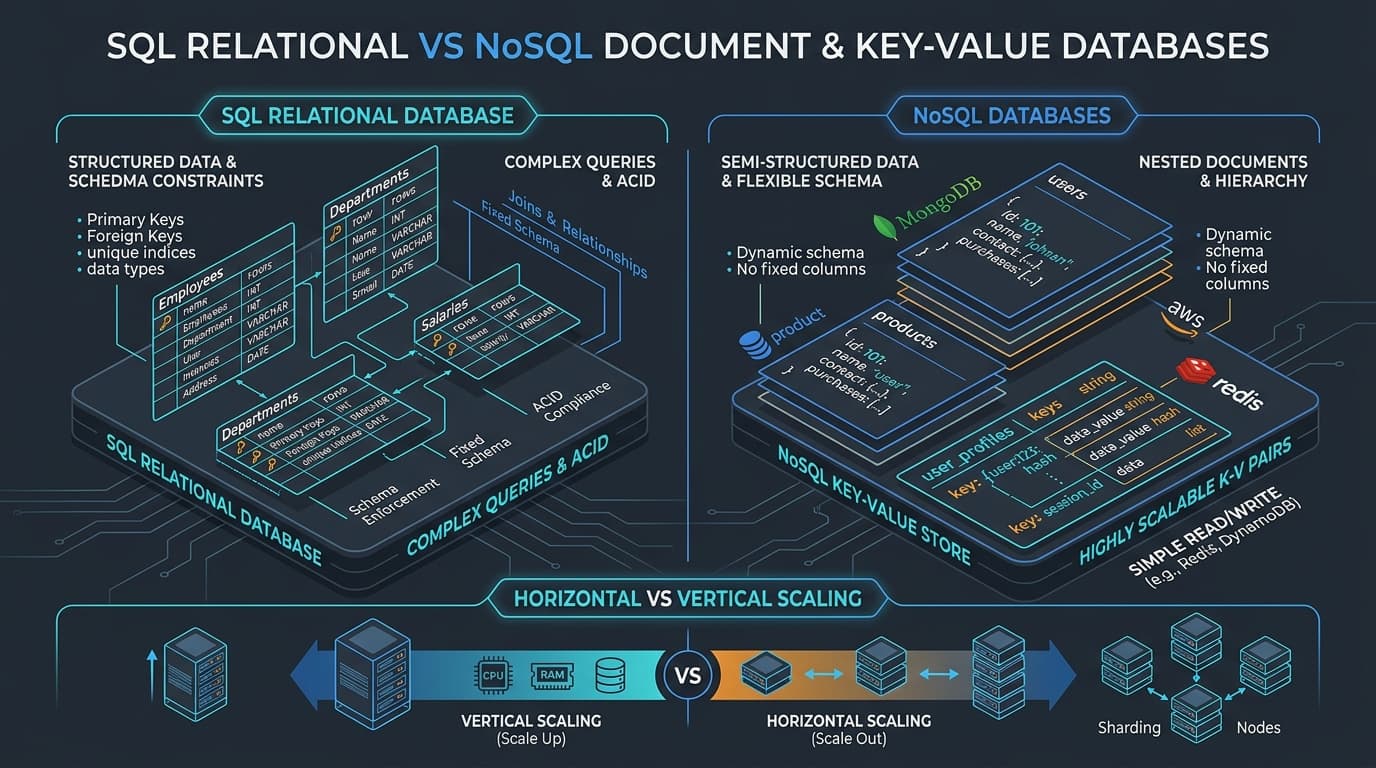
The database layer is the foundational pillar of application reliability, query performance, and long-term scalability. Data storage mistakes made early in development are notoriously difficult and costly to refactor after reaching production scale.
Today, the binary debate of "SQL vs NoSQL" has evolved. Modern architectures embrace polyglot persistence—deploying purpose-built database engines (relational, document, key-value, vector, and time-series) alongside each other to handle specific data workloads with maximum efficiency.
1. The Core Paradigm: Relational Tables vs Document/Key-Value Models
Understanding the fundamental storage and access models is the first step in making the correct architectural choice:
- Relational (SQL) Databases (PostgreSQL, MySQL): Data is stored in strictly typed tables with predefined schemas, foreign key relationships, and mathematical relational algebra. They excel at multi-table JOINs and rigorous schema integrity.
- Document Stores (MongoDB, Couchbase): Data is stored as semi-structured JSON/BSON documents. Related nested data (e.g., an invoice and its line items) is stored together within a single document, eliminating JOINs for read operations.
- Key-Value Stores (Redis, Valkey): Ultra-fast in-memory hash maps designed for sub-millisecond retrieval of cached objects, session states, and rate limit counters.
- Wide-Column / Key-Value Cloud Databases (Amazon DynamoDB, Cassandra): Distributed distributed systems built for predictable single-digit millisecond latency at massive scale with automatic horizontal sharding.
| Dimension | Relational (SQL - PostgreSQL) | Document (NoSQL - MongoDB) | Key-Value (NoSQL - Redis) | Distributed Key-Value (DynamoDB) |
|---|---|---|---|---|
| Data Schema | Strict, enforced at write time | Dynamic, flexible schema-on-read | Schemaless strings, hashes, sets | Key-indexed item attributes |
| ACID Guarantee | Full ACID compliance across tables | Multi-document ACID (with tuning) | Single-command atomic operations | ACID within transactions, tunable |
| Scaling Model | Vertical scaling + read replicas | Horizontal sharding & clustering | In-memory clustering & sharding | Automated horizontal cloud partition |
| Complex Queries | Rich SQL, complex JOINs, CTEs | Aggregation pipeline, nested filtering | Key lookups & range queries | Primary / Sort key index queries only |
| Ideal Workload | Financial ledgers, SaaS core entities | Content catalogs, user profiles, CMS | Session state, cache, leaderboards | High-scale event logs, IoT, carts |
2. ACID Transactions vs BASE and the CAP Theorem
The theoretical foundation dividing these systems centers on consistency models:
A. ACID in Relational Systems
Relational databases guarantee Atomicity (all operations succeed or all fail), Consistency (rules and constraints never broken), Isolation (concurrent transactions execute without interference), and Durability (committed data survives crashes). This is indispensable for financial transactions, billing systems, inventory allocation, and compliance-sensitive records.
B. BASE in Distributed NoSQL Systems
High-throughput distributed systems prioritize Basically Available, Soft state, and Eventual consistency. In accordance with the CAP Theorem (Consistency, Availability, Partition Tolerance), distributed systems running across physical network partitions must choose between strict consistency (CP) or continuous availability (AP).
3. The Modern Modernity: PostgreSQL as a Multi-Model Powerhouse
One of the most significant shifts in modern software architecture is the evolution of PostgreSQL into a multi-model database engine. With native JSONB data types and GIN indexing, PostgreSQL often eliminates the need for a separate document database like MongoDB:
-- Creating a hybrid table in PostgreSQL with structured columns and flexible JSONB
CREATE TABLE enterprise_events (
  id UUID PRIMARY KEY DEFAULT gen_random_uuid(),
  tenant_id UUID NOT NULL REFERENCES tenants(id),
  event_type VARCHAR(100) NOT NULL,
  created_at TIMESTAMPTZ DEFAULT NOW(),
  metadata JSONB NOT NULL DEFAULT '{}'
);

-- Fast GIN index for deep querying inside JSON documents
CREATE INDEX idx_events_metadata_gin ON enterprise_events USING GIN (metadata);

-- Querying nested JSON properties with standard SQL
SELECT id, metadata->>'user_email' AS email
FROM enterprise_events
WHERE metadata @> '{"status": "completed", "tier": "enterprise"}';
4. Polyglot Persistence: Real-World Architecture Blueprint
Modern high-scale platforms do not pick a single database; they assemble an orchestrated data topology:
- Core Relational System (PostgreSQL): Stores users, billing, subscriptions, access control (RBAC), and relational business entities with ACID guarantees.
- In-Memory Layer (Redis): Caches hot API responses, handles JWT blacklists, tracks real-time websocket sessions, and enforces rate limits.
- Search Engine (Elasticsearch / Meilisearch): Powers full-text search, typo-tolerant product discovery, and faceted filtering across millions of records.
- Vector Database (pgvector / Pinecone): Stores AI embeddings for Semantic Search, RAG (Retrieval-Augmented Generation), and LLM recommendation agents.
- Time-Series / Analytics (ClickHouse / TimescaleDB): Ingests billions of high-velocity telemetry logs, clickstream events, and financial timeseries data.
5. Decision Checklist: How to Choose for Your Next Project
Follow these architectural rules when selecting your primary database:
- If your data relationships are interconnected (users have teams, teams have projects, projects have invoices), start with PostgreSQL. You can always add JSONB fields for dynamic data.
- If your data is hierarchical, read frequently in full units, and schema requirements change daily with unpredictable attributes, evaluate MongoDB.
- If you require predictable, millisecond read/write latency at millions of requests per second with linear horizontal scaling, evaluate Amazon DynamoDB.
- Always incorporate Redis in front of your primary database to offload transient read traffic and protect database connection pools.
Designing an enterprise database schema or scaling a high-concurrency database cluster? Explore ByteOperator's backend development services, our cloud infrastructure engineering, or consult with our data architects.
Related reading:
- How Much Does Custom Software Development Cost in 2026? A Complete Pricing Guide
- AI Agents for Business: How to Automate Operations in 2026 (With Real Use Cases)
- Headless Commerce vs Traditional Ecommerce: Which Architecture Is Right for Your Brand?
- Technical SEO Checklist for 2026: 30 Checks to Get Your Site Crawled, Indexed and Ranked
- How to Build a SaaS MVP in 2026: A Step-by-Step Guide from Idea to Launch
- Generative Engine Optimization (GEO): How to Get Your Brand Cited in AI Search
- Ecommerce Platform Migration: How to Replatform Without Losing SEO Rankings
- Custom Shopify App Development (2026): Architecture, Remix & GraphQL
- Enterprise AI Automation & Agentic Workflows: Architecture & Guardrails (2026)
- Full-Stack SaaS Architecture with Next.js App Router & PostgreSQL (2026)
- Shopify to Custom Platform Migration: Architecture & Execution (2026)
- Shopify Speed Optimization Guide 2026: Core Web Vitals, LCP & Performance Best Practices
- MERN Stack Web Development Guide 2026: MongoDB, Express, React & Node.js
- API Integration Best Practices 2026: REST, GraphQL, Webhooks & Third-Party Reliability
- eCommerce Conversion Rate Optimization (CRO) Guide 2026: Tactics, Testing & Checkout
- How to Measure ROI on AI Automation: A Business Guide for 2026
- Web3 & Blockchain Development Guide 2026: Smart Contracts, dApps & DeFi
- React Performance Optimization Guide 2026: Bundle Size, Rendering & React 19
- Multi-Tenant SaaS Architecture Guide 2026: Database Models, Isolation & Scaling
- eCommerce Email Marketing Strategy 2026: Automation Flows, Segmentation & Klaviyo
- Cloud Cost Optimization Guide 2026: AWS, GCP & Azure FinOps Strategies
- Enterprise RAG Architecture Guide 2026: Vector Search, Hybrid Retrieval & LLM Systems
- Event-Driven Architecture & Microservices: Kafka, RabbitMQ & Distributed Systems
- DevOps & CI/CD Pipeline Best Practices 2026: GitOps, Kubernetes & Zero-Downtime Releases
- Web Application Security & OWASP Top 10 Guide: Hardening Full-Stack Applications
- Headless CMS Architecture with Next.js 2026: Sanity, Strapi & Contentful Comparison
- GraphQL vs REST API Architecture: Performance, Scalability & Best Practices in 2026
- Enterprise Prompt Engineering & LLM Architecture: Production Techniques for 2026
- Monolithic vs Microservices Architecture in 2026: The Modular Monolith & Beyond
- Cross-Platform Mobile App Architecture: React Native vs Flutter vs Swift & Kotlin 2026
Frequently asked questions
When should I choose PostgreSQL over MongoDB?
Choose PostgreSQL whenever your application requires strict data relationships (foreign keys), complex multi-table JOINs, rock-solid ACID financial transactions, or rigorous schema enforcement. PostgreSQL can also store and index JSONB documents efficiently, making it the most versatile default database for modern applications.
What is Polyglot Persistence?
Polyglot Persistence is the architectural practice of using different database engines within the same application architecture, where each database is chosen to handle the specific data structure and query pattern it is optimized for (e.g., PostgreSQL for relational data, Redis for caching, ClickHouse for analytics).
Can NoSQL databases support ACID transactions?
Yes, modern NoSQL databases like MongoDB (since version 4.0) and Amazon DynamoDB support multi-document/multi-item ACID transactions. However, transactions in distributed NoSQL systems introduce latency overhead and require careful partition key planning compared to native relational engines.
How do read replicas improve database performance?
Read replicas are duplicate instances of your primary database that continuously synchronize changes via asynchronous replication. By routing read-heavy queries (e.g., search, reports, public catalog browsing) to replicas, you free up the primary master database to handle critical write transactions without connection exhaustion.