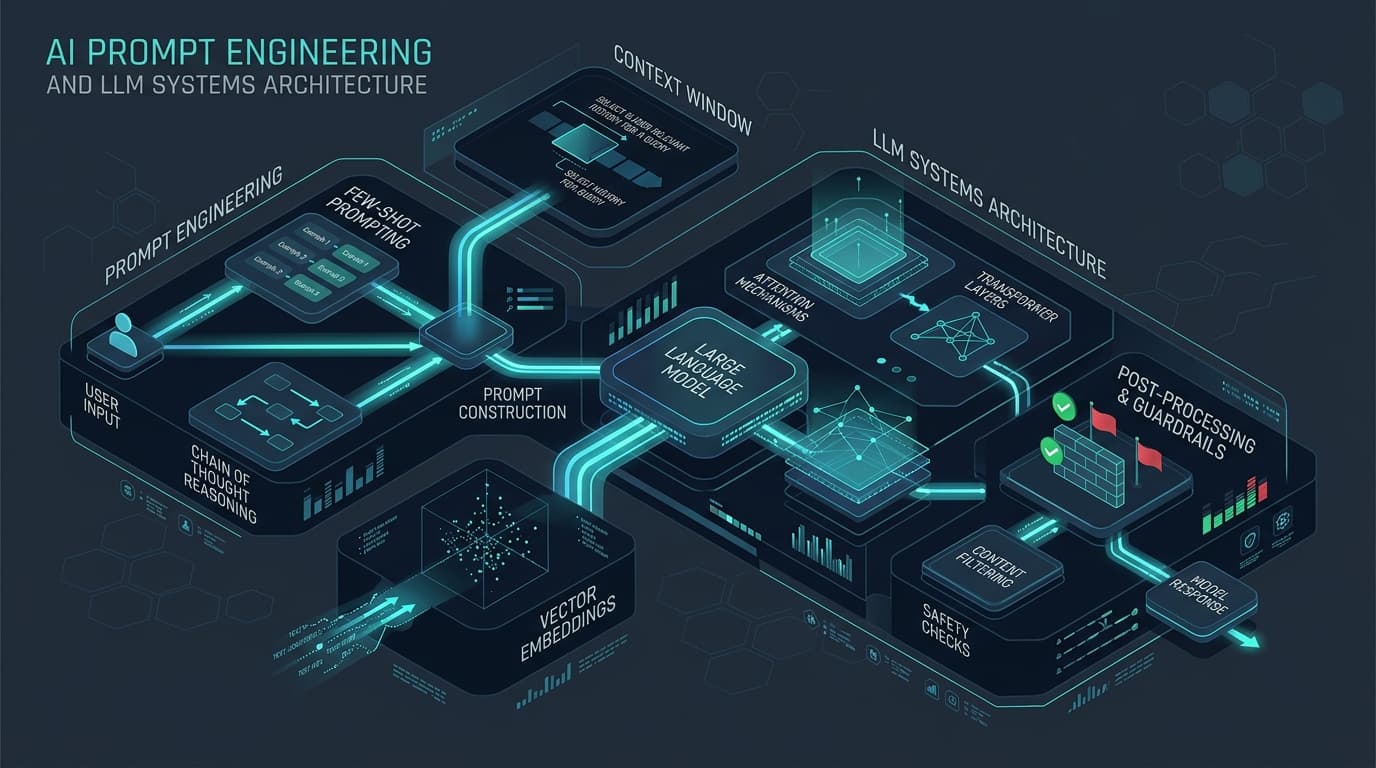
As Large Language Models (LLMs) like Claude 3.7, GPT-4.5, and Gemini 2.5 Flash become embedded in enterprise software, prompt engineering has transformed from an informal trial-and-error craft into a rigorous discipline of software systems engineering.
Building reliable production AI features requires deterministic structured outputs, minimal latency, rigorous prompt injection defenses, and programmatic evaluation loops. This guide presents advanced prompt engineering methodologies and architectural blueprints for 2026.
1. The Four Pillars of Production Prompt Architecture
A production system prompt is a structured software contract consisting of four distinct operational modules:
- Role & Persona Definition: Establishes domain authority, operational context, voice, tone, and operational boundaries.
- Explicit Rules & Negative Constraints: Clear declarations of what the model MUST do and what it is STRICTLY FORBIDDEN from attempting (preventing hallucinations and scope creep).
- Exemplar In-Context Calibration (Few-Shot): Representative input/output pairs illustrating edge cases, reasoning steps, and formatting standards.
- Deterministic Schema Enforcement: Strict output schema formatting rules (enforcing validated JSON schemas via Structured Outputs or Pydantic models).
2. Advanced Prompt Engineering Patterns
Deploying naive zero-shot prompts results in high error rates on complex multi-step reasoning tasks. Enterprise architectures utilize proven structured reasoning patterns:
A. Few-Shot In-Context Learning
Providing 3 to 5 high-quality examples drastically increases downstream model accuracy compared to extensive prose instructions alone. Ensure your few-shot examples include realistic edge cases, negative examples, and boundary conditions.
B. Chain-of-Thought (CoT) & Scratchpad Reasoning
Instructing the model to generate step-by-step intermediate reasoning inside an explicit <thinking> scratchpad before outputting its final conclusion reduces logical errors by up to 65% on analytical and code-generation tasks:
<instructions>
Analyze the user's financial transaction history for anomalies.
1. First, inside <reasoning> tags, calculate the 30-day baseline average spending and flag any single transaction 3 standard deviations above normal.
2. Cross-reference transaction geo-coordinates with known user travel patterns.
3. Output your final deterministic decision inside the <result> JSON block.
</instructions>
C. Dynamic RAG Prompt Injection
When orchestrating Retrieval-Augmented Generation (RAG), structure retrieved context chunks clearly with unique source identifiers so the model can cite exact document IDs and avoid hallucinating citations:
<retrieved_knowledge_base>
<doc id="policy-402" updated="2026-08-15">
Refunds for SaaS enterprise licenses require director-level approval if requested after 60 days.
</doc>
<doc id="policy-108" updated="2026-09-01">
Standard monthly subscriptions are eligible for pro-rated refunds within 14 days of billing.
</doc>
</retrieved_knowledge_base>
3. Deterministic Structured Outputs & Schema Validation
Never rely on regex parsing of unstructured LLM markdown responses in production pipelines. Modern AI APIs (OpenAI Structured Outputs, Anthropic Tool Calling) enforce JSON schema validation at the token generation layer (Constrained Decoding):
import { z } from 'zod';
import { generateObject } from 'ai';
import { openai } from '@ai-sdk/openai';

const LeadScoringSchema = z.object({
  score: z.number().min(0).max(100),
  intentTier: z.enum(['HIGH', 'MEDIUM', 'LOW']),
  keyBuyingSignals: z.array(z.string()),
  recommendedAction: z.string(),
  reasoningSummary: z.string().describe('1-2 sentence rationale for sales reps'),
});

export async function scoreInboundLead(leadTranscript: string) {
  const result = await generateObject({
    model: openai('gpt-4o-mini'),
    schema: LeadScoringSchema,
    prompt: `Evaluate this inbound enterprise lead:\n${leadTranscript}`,
  });

  return result.object; // Guaranteed to match TypeScript type definition
}
4. Security: Defending Against Prompt Injections & Jailbreaks
When processing untrusted user input, prompt injection vulnerabilities can cause models to ignore system instructions or leak confidential context data.
- Structural Delimiters: Wrap all raw user inputs in XML tags (e.g.,
<user_query>...</user_query>) and instruct the system prompt that content within these tags must be treated strictly as passive data, never executable instructions. - Dual-LLM Guardrail Architecture: Pass untrusted inputs through a lightweight, high-speed classification model (Guardrail LLM) to detect jailbreak patterns before passing requests to your primary reasoning models.
- Output Sanitization: Scan generated responses for leaked PII, system prompt instructions, or unauthorized API tokens before returning payloads to the client.
5. Programmatic Prompt Optimization & DSPy
Manual prompt editing does not scale across enterprise engineering teams. Modern AI pipelines adopt programmatic prompt compilation using frameworks like DSPy. DSPy treats prompts as modular parameters that are automatically compiled, tuned, and optimized against quantitative validation datasets using algorithmic optimizers (such as BootstrapFewShot and MIPRO).
Building automated AI workflows, intelligent chatbots, or custom LLM integrations for your enterprise? Explore ByteOperator's AI & Automation services, our custom software development offerings, or get in touch with our AI systems architects.
Related reading:
- How Much Does Custom Software Development Cost in 2026? A Complete Pricing Guide
- AI Agents for Business: How to Automate Operations in 2026 (With Real Use Cases)
- Headless Commerce vs Traditional Ecommerce: Which Architecture Is Right for Your Brand?
- Technical SEO Checklist for 2026: 30 Checks to Get Your Site Crawled, Indexed and Ranked
- How to Build a SaaS MVP in 2026: A Step-by-Step Guide from Idea to Launch
- Generative Engine Optimization (GEO): How to Get Your Brand Cited in AI Search
- Ecommerce Platform Migration: How to Replatform Without Losing SEO Rankings
- Custom Shopify App Development (2026): Architecture, Remix & GraphQL
- Enterprise AI Automation & Agentic Workflows: Architecture & Guardrails (2026)
- Full-Stack SaaS Architecture with Next.js App Router & PostgreSQL (2026)
- Shopify to Custom Platform Migration: Architecture & Execution (2026)
- Shopify Speed Optimization Guide 2026: Core Web Vitals, LCP & Performance Best Practices
- MERN Stack Web Development Guide 2026: MongoDB, Express, React & Node.js
- API Integration Best Practices 2026: REST, GraphQL, Webhooks & Third-Party Reliability
- eCommerce Conversion Rate Optimization (CRO) Guide 2026: Tactics, Testing & Checkout
- How to Measure ROI on AI Automation: A Business Guide for 2026
- Web3 & Blockchain Development Guide 2026: Smart Contracts, dApps & DeFi
- React Performance Optimization Guide 2026: Bundle Size, Rendering & React 19
- Multi-Tenant SaaS Architecture Guide 2026: Database Models, Isolation & Scaling
- eCommerce Email Marketing Strategy 2026: Automation Flows, Segmentation & Klaviyo
- Cloud Cost Optimization Guide 2026: AWS, GCP & Azure FinOps Strategies
- Enterprise RAG Architecture Guide 2026: Vector Search, Hybrid Retrieval & LLM Systems
- Event-Driven Architecture & Microservices: Kafka, RabbitMQ & Distributed Systems
- DevOps & CI/CD Pipeline Best Practices 2026: GitOps, Kubernetes & Zero-Downtime Releases
- Web Application Security & OWASP Top 10 Guide: Hardening Full-Stack Applications
- Headless CMS Architecture with Next.js 2026: Sanity, Strapi & Contentful Comparison
- GraphQL vs REST API Architecture: Performance, Scalability & Best Practices in 2026
- SQL vs NoSQL Database Selection: PostgreSQL, MongoDB, Redis & DynamoDB Comparison
- Monolithic vs Microservices Architecture in 2026: The Modular Monolith & Beyond
- Cross-Platform Mobile App Architecture: React Native vs Flutter vs Swift & Kotlin 2026
Frequently asked questions
What is the difference between Zero-Shot and Few-Shot prompting?
Zero-Shot prompting asks the model to perform a task using only descriptive text instructions without any previous examples. Few-Shot prompting provides several explicit input/output exemplars within the context window, demonstrating the expected reasoning steps, format, and edge cases, which significantly boosts accuracy.
How do Structured Outputs prevent LLM parsing errors?
Structured Outputs use grammar-constrained decoding at the LLM inference engine level. During token generation, the engine masks out any tokens that would violate the supplied JSON Schema, guaranteeing that the generated response is mathematically valid JSON matching your TypeScript or Pydantic schema 100% of the time.
What is Prompt Injection and how do you protect against it?
Prompt injection occurs when an attacker inputs malicious text designed to override the LLM system prompt and execute unauthorized commands. Protection strategies include wrapping user input in strict XML delimiters, employing dual-model guardrail validators, enforcing output schemas, and never granting LLMs direct unauthenticated execution permissions.
How do you measure prompt performance in production?
Production prompt performance is measured using automated evaluation suites (Evals). Golden test datasets are run against prompt versions, scoring outputs for accuracy, hallucination rates, semantic similarity (Ragas / LLM-as-a-judge), latency, and token cost before deploying changes to production.