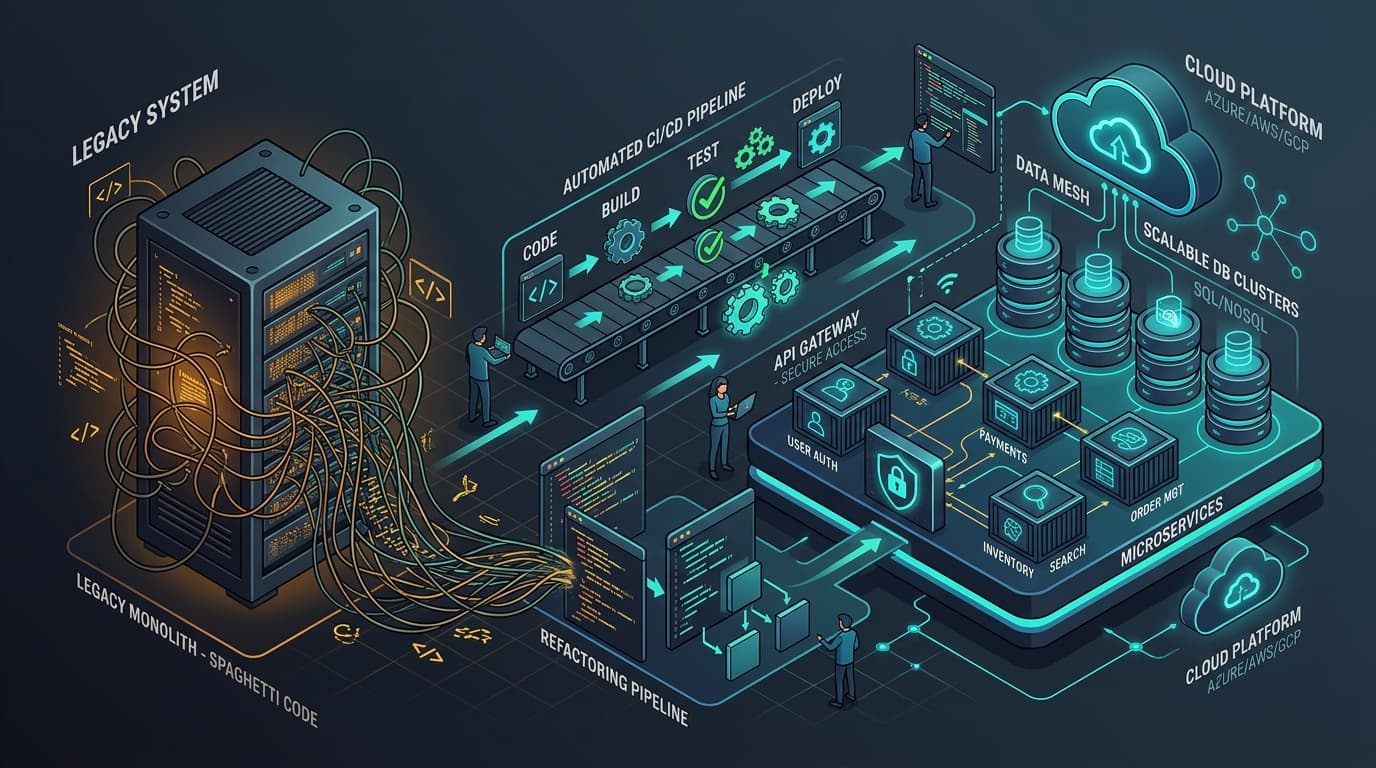
Outdated legacy software systems are the single greatest bottleneck to enterprise innovation, cybersecurity compliance, and employee productivity. Monolithic codebases built a decade ago in legacy PHP, ASP.NET, or early Java frameworks frequently suffer from missing documentation, severe security vulnerabilities, brittle database schemas, and skyrocketing cloud maintenance costs.
However, attempting a high-risk "Big Bang" complete system rewrite frequently leads to catastrophic project delays, budget overruns, and unexpected operational downtime. In 2026, forward-thinking enterprises use disciplined, incremental modernization strategies that deliver tangible business value from sprint one while keeping mission-critical systems 100% operational.
In this comprehensive enterprise guide, Byte Operator outlines the modern architectural blueprints, risk frameworks, and migration patterns required to transform legacy liabilities into scalable competitive assets.
1. The 7 Rs Framework of Software Modernization
Every legacy component must be evaluated against the standard cloud modernization framework:
| Strategy | Engineering Action | Risk & Effort | Best Use Case |
|---|---|---|---|
| 1. Rehost (Lift & Shift) | Move existing application from on-prem hardware to cloud VMs (AWS EC2 / Azure) without code changes. | Low Risk / Low Effort | Immediate data center lease expiration with stable codebase. |
| 2. Replatform | Upgrade underlying runtime, migrate self-hosted databases to managed cloud DBs (Amazon RDS / Cloud SQL). | Medium Risk / Medium Effort | Eliminating database maintenance and hardware patch fatigue. |
| 3. Refactor (Modularize) | Restructure internal spaghetti code into clean Domain-Driven Design (DDD) modules without altering external behavior. | Medium Risk / High Effort | Codebase is viable but developer velocity has slowed due to high tech debt. |
| 4. Rearchitect (Strangler Fig) | Incrementally replace monolithic services with modern microservices or serverless functions behind an API Gateway. | Medium Risk / High Value | High-traffic enterprise applications requiring 24/7 zero-downtime uptime. |
| 5. Rebuild (Greenfield) | Engineer a fresh modern application from scratch using Next.js, TypeScript, and modern cloud primitives. | High Risk / Maximum Value | Legacy system technology is completely end-of-life and unmaintainable. |
2. The Strangler Fig Pattern: Zero Downtime Modernization Blueprint
The Strangler Fig Pattern is the gold standard for enterprise software modernization. Rather than risking a full system shutdown, you systematically replace legacy capabilities one piece at a time:
- Step 1: Interception Layer (API Gateway): Deploy an edge API Gateway (Kong, Envoy, or Cloudflare Workers) in front of the legacy monolith. All customer requests pass through the gateway transparently.
- Step 2: Identify High-Value Decoupled Service: Select an isolated domain (such as User Authentication, Billing Ingestion, or Report Generation) that delivers immediate business leverage.
- Step 3: Engineer Modern Cloud Service: Build the new module using modern TypeScript, Next.js, or Go with dedicated database models and automated CI/CD pipelines.
- Step 4: Reroute Traffic & Validate: Configure the API Gateway to route specific URL paths (e.g.,
/api/v2/billing/*) to the new microservice while routing all other traffic to the legacy backend. - Step 5: Decommission & Repeat: Once the new module runs with zero errors in production for 30 days, purge the legacy module code and move to the next domain.
3. The Hidden Financial Cost of Delaying Modernization
Maintaining outdated legacy applications incurs massive hidden operational expenses:
- Hiring Scarcity Tax: Finding engineers willing to write legacy ColdFusion, PHP 5.4, or old ASP.NET costs 30% to 50% more in compensation premiums.
- Security & Compliance Fines: Outdated frameworks with unpatchable CVE vulnerabilities violate SOC2, HIPAA, and GDPR compliance mandates, risking catastrophic data breaches.
- Slow Feature Velocity: Simple UI changes or API integrations that take 2 days on Next.js take 3 weeks on legacy monoliths, causing you to lose ground to agile competitors.
4. How Byte Operator Executes Enterprise Modernization
At Byte Operator, our senior software architects and platform engineers follow a structured 4-stage modernization framework:
- 1. Deep Codebase & Architecture Audit: Automated dependency scanning, static code analysis, and database schema profiling to map every undocumented dependency.
- 2. Risk-Scored Migration Roadmap: Prioritizing modules by business impact, technical risk, and ROI.
- 3. Parallel Execution & Automated Testing: Building characterization test suites and automated end-to-end integration tests to guarantee zero regression bugs.
- 4. Turnkey Handover & Team Training: Complete TypeScript documentation, architectural diagrams, and developer enablement.
Ready to modernize your legacy applications with guaranteed zero downtime? Discover ByteOperator's Platform Migration Services, our Technical Software Audits, or request a confidential architecture review with our senior engineering team today.
Related reading:
- How Much Does Custom Software Development Cost in 2026? A Complete Pricing Guide
- AI Agents for Business: How to Automate Operations in 2026 (With Real Use Cases)
- Headless Commerce vs Traditional Ecommerce: Which Architecture Is Right for Your Brand?
- Technical SEO Checklist for 2026: 30 Checks to Get Your Site Crawled, Indexed and Ranked