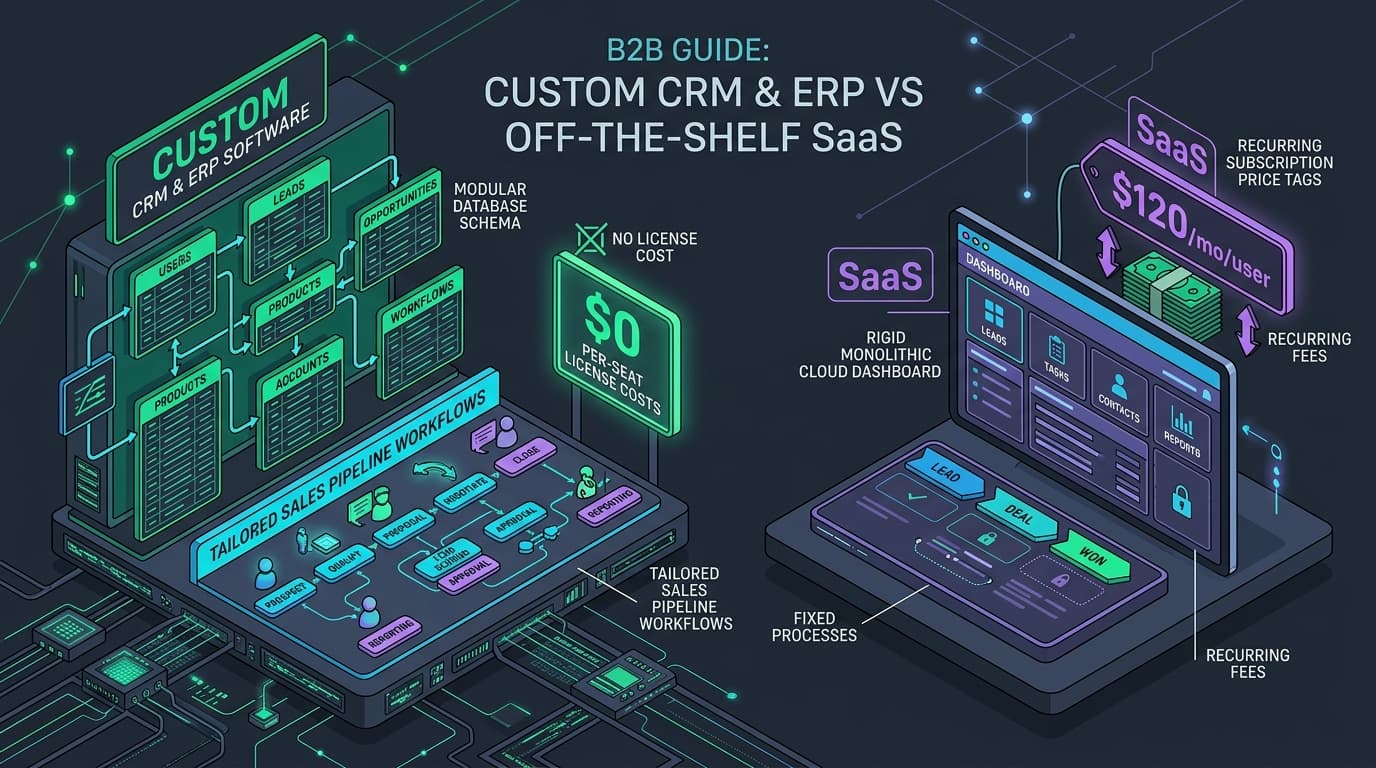
For mid-market and enterprise businesses, customer relationship management (CRM) and enterprise resource planning (ERP) platforms are the operational heartbeat of the company. However, as organizations scale from 20 to 200+ employees, off-the-shelf software packages like Salesforce, HubSpot Enterprise, and NetSuite often transform into massive cost centers characterized by per-seat license fatigue, rigid workflows, and expensive implementation consultants.
In 2026, advances in modern web frameworks (Next.js, React, Supabase, Postgres) and low-latency API architectures have made building bespoke, proprietary business platforms faster and more cost-effective than ever before. This guide delivers an objective, financially grounded comparison between building custom business software and subscribing to commercial SaaS.
1. The 5-Year Total Cost of Ownership (TCO) Comparison
Commercial SaaS platforms look affordable at small team tiers ($50/user/mo), but as you unlock enterprise permissions, custom objects, API call volume limits, and storage add-ons, costs compound exponentially:
| Expense Category | Commercial SaaS (Salesforce / HubSpot - 75 Users) | Bespoke Custom Platform (Byte Operator) |
|---|---|---|
| Annual Per-Seat Licenses | $135,000 / yr ($150/user/mo average tier) | $0 (Unlimited user seats forever) |
| Initial Implementation / Setup | $45,000 – $90,000 (Certified Salesforce/HubSpot agency fees) | $65,000 – $140,000 (Complete ground-up engineering) |
| API Limit & Storage Overages | $12,000 – $25,000 / yr | $0 (Standard cloud database hosting costs ~$150/mo) |
| Ongoing Support & Maintenance | $25,000 / yr (Retainer for external CRM admin/consultant) | $15,000 / yr (Cloud hosting & minor updates) |
| 5-Year Cumulative Investment | $845,000+ (Zero Equity Asset) | $180,000 – $240,000 (100% Proprietary IP Asset) |
Break-even analysis: For teams with 35+ users, a custom CRM or ERP platform typically achieves complete ROI break-even within 14 to 20 months, generating hundreds of thousands of dollars in cumulative cash savings over a 5-year window.
2. Beyond Cost: The Workflow & Competitive Advantage Factor
While cost is significant, operational agility and data ownership are often the primary drivers for custom engineering:
- Zero Workflow Compromises: Commercial platforms force your business processes to adapt to their rigid software schema. A custom CRM mirrors your exact operational sales cycle, custom quoting logic, partner referral structures, and multi-tier commission rules without workarounds.
- Speed & Response Latency: Monolithic cloud CRMs with dozens of installed plugins take 3 to 6 seconds to load client profiles. A lightweight Next.js + Postgres CRM loads customer timelines and records in under 80ms.
- Proprietary AI Agent Integration: Custom software allows you to embed autonomous AI agents (powered by OpenAI or Anthropic) directly into database triggers—automatically parsing inbound client PDFs, drafting customized pricing quotes, and scoring leads with zero third-party middleware tax.
- Enterprise Data Sovereignty: You maintain 100% control over customer data, stored securely in your private cloud (AWS, Google Cloud) with customized encryption and backup policies.
3. When Buying Off-the-Shelf SaaS Makes Sense
Building custom software is not the right choice for every scenario. You should choose Salesforce or HubSpot if:
- You have fewer than 15 total system users and standard pipeline requirements.
- You need to launch a sales tracking system tomorrow with zero engineering cycle investment.
- Your internal processes are standard and do not require proprietary integrations or algorithms.
4. The Architectural Blueprint for a Modern Custom CRM / ERP
When Byte Operator engineers custom business management systems, we utilize a modern, high-velocity architecture:
- Frontend Dashboard: Next.js App Router with React Server Components and Tailwind CSS for instant page transitions.
- Database & Auth: PostgreSQL with Row-Level Security (RLS) for rock-solid multi-department permission scoping.
- Automated Workflows: Real-time event webhooks and background workers (Redis BullMQ / Inngest) for instant notifications, automated invoicing, and email synchronization.
- Native Integrations: Direct API synchronizations with Stripe, QuickBooks, DocuSign, Slack, and your customer-facing applications.
Thinking about escaping per-seat subscription fees or building a tailored internal platform? Explore ByteOperator's Custom Software Engineering and System Integrations, or contact our software architects for a free TCO consultation.
Related reading:
- How Much Does Custom Software Development Cost in 2026? A Complete Pricing Guide
- AI Agents for Business: How to Automate Operations in 2026 (With Real Use Cases)
- Headless Commerce vs Traditional Ecommerce: Which Architecture Is Right for Your Brand?
- Technical SEO Checklist for 2026: 30 Checks to Get Your Site Crawled, Indexed and Ranked