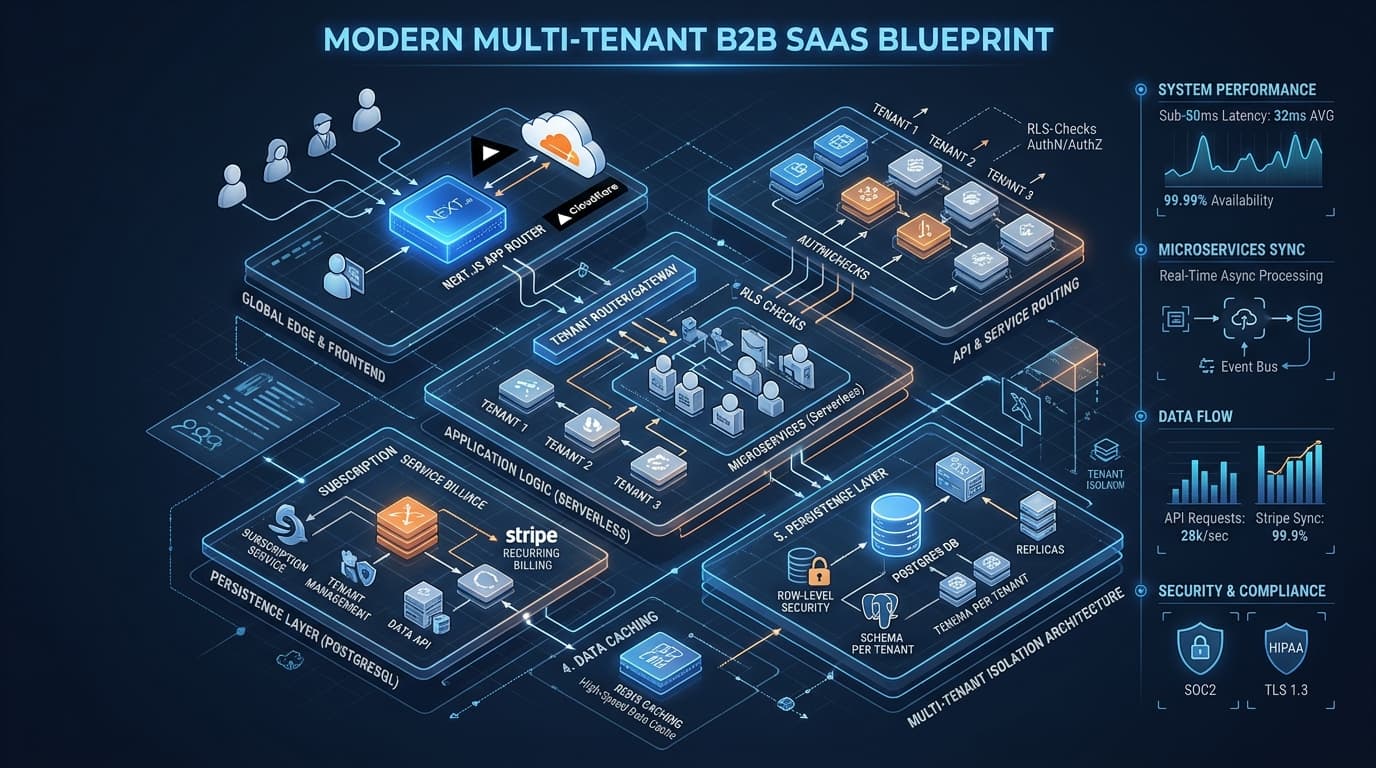
Building a successful B2B SaaS platform in 2026 requires more than a simple web app with authentication. Enterprise buyers demand strict tenant isolation, lightning-fast dashboard response times (<50ms), granular role-based access control (RBAC), robust webhook infrastructure, and compliance readiness (SOC2, GDPR).
Choosing the wrong architecture early on results in catastrophic technical debt, sluggish query performance, and expensive multi-month rewrites. In this guide, Byte Operator’s principal software engineers share our battle-tested architecture blueprint, recommended tech stack, and transparent cost models to take your B2B SaaS from MVP to enterprise scale.
1. The 2026 Modern B2B SaaS Tech Stack
Based on building custom platforms for venture-backed startups and established enterprise businesses, here is our recommended production stack:
- Frontend & Edge Application: Next.js (App Router, React 19, Server Components) deployed on Vercel or Cloudflare. Server Components eliminate client-side bundle bloat, stream data instantly, and deliver sub-second Initial Page Loads.
- Database Layer: PostgreSQL (via Supabase or Neon) with connection pooling. Relational integrity with JSONB flexibility provides the optimal foundation for complex B2B relational data models.
- Multi-Tenant Isolation: Postgres Row-Level Security (RLS). RLS ensures that tenant isolation is enforced at the database kernel level—preventing any possibility of cross-tenant data leaks even if application code contains an oversight.
- Billing & Monetization: Stripe Billing + Customer Portal. Supports multi-seat pricing, metered usage billing, annual invoicing, and automated tax calculation.
- Background Jobs & Pipelines: Inngest / Trigger.dev / Redis BullMQ for resilient, retriable background task orchestration, automated data syncs, and PDF generation.
- Authentication & Directory Sync: WorkOS or Supabase Auth with out-of-the-box SAML SSO, Okta integration, and SCIM directory provisioning for enterprise contracts.
2. Multi-Tenant Architecture: Shared Database vs. Database-per-Tenant
One of the earliest architectural crossroads is deciding how to isolate customer data:
| Model | Pros | Cons | Ideal For |
|---|---|---|---|
| Shared DB + Row-Level Security (RLS) | Extremely cost-efficient, effortless database migrations, shared caching, simple global analytics. | Requires diligent index tuning for large multi-million row tables; 'noisy neighbor' risk if unthrottled. | 95% of modern B2B SaaS applications from seed stage to $10M+ ARR. |
| Database-per-Tenant | Absolute physical data isolation, dedicated compute, simple per-tenant backups and compliance audits. | High infrastructure cost overhead, complex multi-database schema migrations, operational complexity. | Regulated enterprise healthcare (HIPAA), government, or tier-1 financial institutions. |
3. The 3 Core Pillars of Enterprise-Grade B2B SaaS
Pillar 1: Granular Role-Based Access Control (RBAC)
Enterprise accounts never have simple 'Admin' and 'User' roles. They require custom roles (Owner, Admin, Billing Manager, Viewer, Auditor) with permissions scoped to specific workspaces. We design permission models using Casbin or policy-driven database functions that evaluate access rights in under 2ms.
Pillar 2: Resilient Webhook Ingestion & Egress
Modern SaaS platforms integrate with customer tools (HubSpot, Salesforce, Slack, ERPs). Incoming webhooks must be immediately acknowledged with a 200 OK and pushed into an async message queue (Redis/SQS) within 50ms, then processed idempotently to prevent duplicate records.
Pillar 3: Comprehensive Audit Logs & Observability
Enterprise procurement teams will ask during vendor security reviews: "Can our security team see who exported this customer list or deleted this workflow?" We build immutable audit log tables tracking user ID, IP address, timestamp, resource changed, and previous state.
4. Transparent Development Cost Models (2026 Benchmarks)
What does it realistically cost to build a high-performance B2B SaaS platform with a professional engineering agency?
- Tier 1: Focused MVP (Weeks 4–8) — $35,000 to $65,000: Complete core product workflow, Supabase auth, Stripe billing, clean responsive dashboard UI, and foundational analytics. Designed to validate market demand and onboard your first 50 paying business customers.
- Tier 2: Production-Grade Scaling Platform (Weeks 8–16) — $75,000 to $160,000: Multi-tenant Postgres RLS architecture, team workspace collaboration, complex third-party API integrations, granular RBAC, async background task queues, and automated customer onboarding funnels.
- Tier 3: Enterprise Platform (Weeks 16+) — $180,000+: Custom AI agent automation workflows, SAML SSO/SCIM provisioning, dedicated enterprise compliance infrastructure, high-throughput microservices, and bespoke custom reporting engines.
Build Your Next SaaS Platform with Byte Operator
Whether you are engineering a ground-up B2B SaaS platform or refactoring an existing application for extreme scalability, Byte Operator delivers full-stack technical excellence.
Explore our Custom Software & SaaS Development capabilities, or book an engineering discovery session with our technical leadership today.
Related reading:
- How Much Does Custom Software Development Cost in 2026? A Complete Pricing Guide
- AI Agents for Business: How to Automate Operations in 2026 (With Real Use Cases)
- Headless Commerce vs Traditional Ecommerce: Which Architecture Is Right for Your Brand?
- Technical SEO Checklist for 2026: 30 Checks to Get Your Site Crawled, Indexed and Ranked
Frequently asked questions
Why do you recommend Next.js App Router for B2B SaaS over traditional SPAs?
Next.js App Router combines React Server Components with edge caching, drastically reducing JavaScript sent to the browser. This results in sub-50ms dashboard page loads, immediate search engine indexing for marketing routes, and seamless server-side authentication without token flashes.
How do you handle multi-tenant data privacy and security?
We implement PostgreSQL Row-Level Security (RLS) policies. Every query automatically filters rows by tenant_id at the database engine level, ensuring that tenant A can never access tenant B's records even in the event of an application-level bug.
Can you help us build enterprise features like SAML SSO and SOC2 compliance?
Yes. We regularly implement enterprise authentication via SAML 2.0 (Okta, Azure AD, Google Workspace), SCIM user provisioning, encrypted audit logs, and SOC2 Type II compliant cloud infrastructure on AWS and Vercel.
How does Byte Operator structure software development engagements?
We operate on transparent milestone-based deliverables or dedicated senior engineering pods. You get direct access to senior full-stack architects, bi-weekly production demos, automated CI/CD staging environments, and 100% intellectual property ownership from day one.