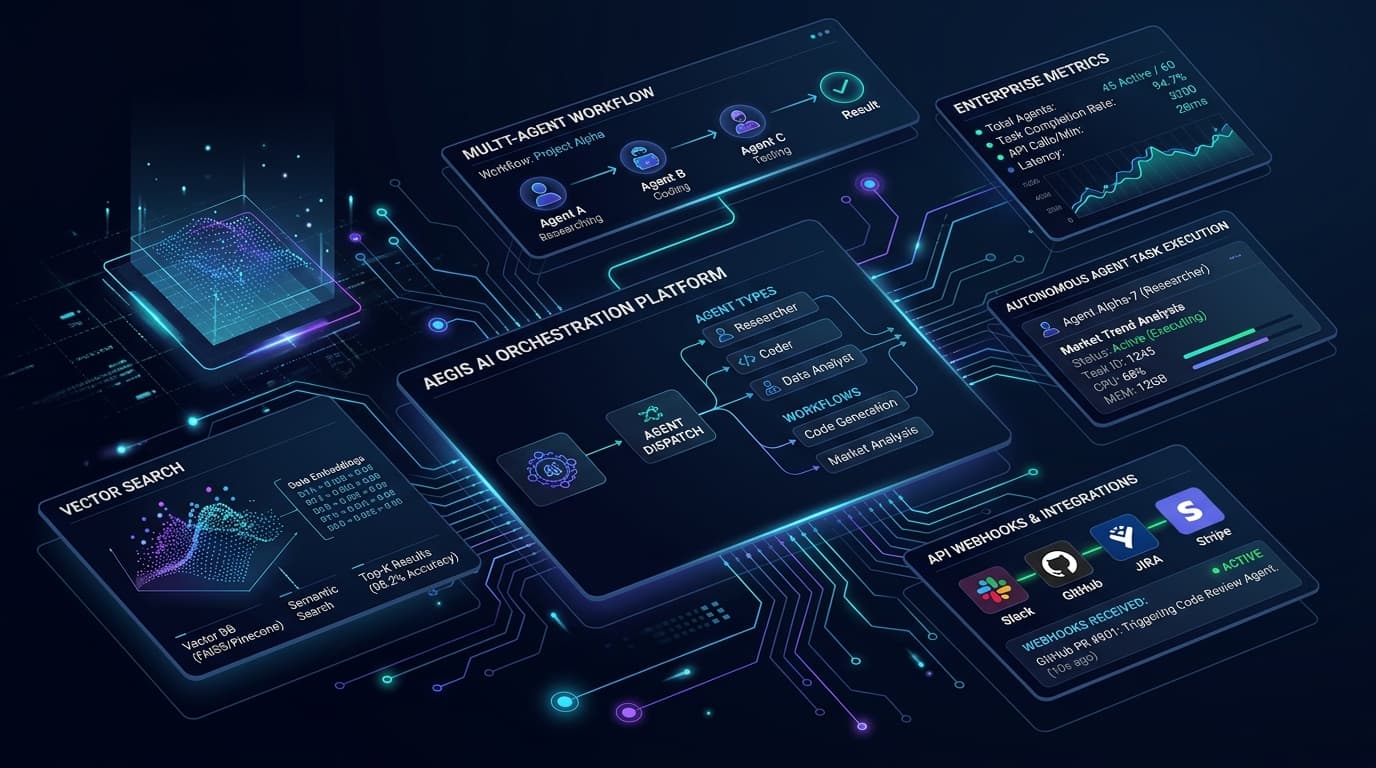
Deploying autonomous AI agents into enterprise production is fundamentally different from building proof-of-concept chatbots. Production systems require deterministic tool calling, multi-tenant state persistence, human-in-the-loop escalation gates, and rigorous telemetry. When engineered properly, multi-agent swarms automate mission-critical operations—slashing operational overhead by 40% to 65% while accelerating execution speeds from hours to seconds.
At Byte Operator, we engineer enterprise agent systems (including our proprietary Replex Engine and custom n8n multi-agent clusters) for high-growth commerce brands, SaaS platforms, and enterprise operators. In this guide, we break down the production architecture, orchestration framework comparisons, failure recovery patterns, and concrete ROI metrics required to deploy AI agents that reliably run core business operations.
1. The Evolution: From Single LLM Prompts to Multi-Agent Swarms
Single-prompt LLM wrappers fail in enterprise production because real-world business workflows are non-linear, multi-step, and stateful. An order reconciliation issue or automated customer qualification pipeline cannot be resolved by a single API call.
Modern production systems utilize Specialized Multi-Agent Swarms, where discrete autonomous agents collaborate under an orchestrator:
- Supervisor / Orchestrator Agent: Evaluates incoming webhooks or user intents, decomposes complex goals into subtasks, and assigns them to specialized downstream agents with strict context windows.
- Retrieval & Research Agent: Queries enterprise vector databases (Pinecone, pgvector) and real-time APIs (Stripe, HubSpot, Shopify Admin GraphQL) to build factual ground truth.
- Action & Tool Execution Agent: Executes sandboxed mutations (issuing refunds, generating invoices, modifying database records, updating CRM fields) through validated schemas.
- Evaluator / Verification Agent: Inspects proposed actions before execution, cross-checking against corporate compliance rules, rate limits, and sanity checks.
2. Framework Comparison: LangGraph vs. CrewAI vs. AutoGen vs. Custom n8n
Selecting the right orchestration engine dictates your operational maintainability and latency:
| Framework | State Model | Control Flow | Best For |
|---|---|---|---|
| LangGraph | StateGraph with checkpointing (PostgreSQL/Redis) | Cyclic graphs & deterministic human-in-the-loop interrupts | Mission-critical enterprise workflows requiring rigorous rollbacks and audits. |
| n8n Self-Hosted (LangChain nodes) | Execution context + Postgres queue | Visual node graphs + custom JavaScript/Python code nodes | Rapid operational automation connecting 400+ SaaS apps with sub-second webhooks. |
| CrewAI | Sequential / Hierarchical task memory | Role-based autonomous delegation | Content synthesis, multi-source research, and qualitative analytical workflows. |
| Microsoft AutoGen | Conversational message history | Multi-agent chat event loops | Code generation, iterative debugging, and complex simulation environments. |
3. The 4 Non-Negotiable Pillars of Production Agent Architecture
Pillar 1: Deterministic Tool Calling with Pydantic / Zod Schemas
Never let an autonomous model emit raw SQL queries or arbitrary API payloads. All tool executions must be bound to strictly typed schemas with validation at runtime. If the model produces invalid parameters, an automated feedback loop returns the validation error directly to the agent to self-correct before hitting production infrastructure.
Pillar 2: Durable Checkpointing & State Persistence
If an agent workflow crashes halfway through a multi-system migration or customer inquiry, it must resume from the exact state checkpoint without re-running earlier completed actions. Using Postgres checkpoint tables or Redis memory stores guarantees zero double-executions of sensitive operations like payment processing or customer communications.
Pillar 3: Human-in-the-Loop (HITL) Guardrails
For high-value or destructive actions (refunds over $200, bulk database edits, contract approvals), the agent must transition to a paused_waiting_approval state and dispatch a Slack/Teams interactive notification. Once an engineer or manager clicks 'Approve', the workflow resumes deterministically.
Pillar 4: Semantic Caching & Token Cost Optimization
Enterprise workloads process millions of events. By pairing Redis semantic caching with prompt compression techniques, repetitive queries bypass frontier model calls entirely, cutting API costs by 50% to 70% while dropping response latency from 3,500ms down to 45ms.
4. Real-World Case Study: Automated Inbound Lead Qualification
Through Byte Operator's AI Automations & Agents deployment for an enterprise SaaS client, we replaced a manual SDR triage process with an autonomous multi-agent pipeline:
- Inbound Webhook: Form submission triggers an enrichment agent querying Clearbit, Apollo, and LinkedIn within 800ms.
- Scoring Agent: Cross-references ICP criteria against historical CRM close rates.
- Replex Engine Agent: Composes a personalized, technically tailored technical briefing and dispatches it to the founder in under 45 seconds.
- Outcome: Lead response velocity improved from 4.2 hours to 45 seconds, resulting in a 214% increase in scheduled discovery calls within 60 days.
5. How to Calculate Your AI Automation ROI
Before writing a line of code, calculate the net financial impact using this standard enterprise formula:
Annual Net Savings = (Hours Saved/Week × 52 × Hourly Fully Loaded Cost) + Incremental Revenue Captured - (Infrastructure & Model API Costs)
For a 20-person operations team spending 12 hours weekly on manual data syncs, invoice approvals, and client inquiries at $55/hr, the gross annual savings alone exceed $686,400 against an infrastructure and maintenance cost of under $25,000.
Architect Your Custom AI Agent System with Byte Operator
Ready to deploy autonomous AI agents that run with zero downtime, enterprise security, and measurable ROI? Byte Operator's senior software engineers and AI architects build production-ready agent pipelines tailored directly to your technical infrastructure.
Explore our AI Automations & Autonomous Agents capabilities, or book a 30-minute architecture discovery call to map your technical roadmap.
Related reading:
- How Much Does Custom Software Development Cost in 2026? A Complete Pricing Guide
- AI Agents for Business: How to Automate Operations in 2026 (With Real Use Cases)
- Headless Commerce vs Traditional Ecommerce: Which Architecture Is Right for Your Brand?
- Technical SEO Checklist for 2026: 30 Checks to Get Your Site Crawled, Indexed and Ranked
Frequently asked questions
What is the difference between an AI chatbot and an autonomous AI agent?
A chatbot only responds with text based on incoming prompts. An autonomous AI agent has access to external tools, databases, and APIs. It can reason, break down goals into sub-tasks, execute mutations in software, evaluate results, and loop autonomously until the task is verified complete.
How do you prevent AI agents from hallucinating in production?
We implement strict deterministic schema validation (Zod/Pydantic), retrieval-augmented generation (RAG) against verified vector databases, automated evaluator agents that cross-check outputs before execution, and human-in-the-loop approval gates for destructive or financial operations.
Which model should enterprise teams use: Claude 3.5 Sonnet, GPT-4o, or DeepSeek?
In production, we often route dynamically: Claude 3.5 Sonnet excels at complex tool calling, code generation, and multi-step reasoning. GPT-4o delivers ultra-low latency for customer-facing dialogue and multimodal analysis. Lightweight models (like Claude 3.5 Haiku or GPT-4o-mini) handle background classification and enrichment at negligible cost.
How long does it take to build and deploy an enterprise AI agent workflow?
A focused production agent (such as automated lead enrichment, ticket triaging, or invoice reconciliation) is typically scoped, engineered, and deployed in 2 to 4 weeks. Multi-system enterprise agent swarms with custom ERP/CRM integrations take 6 to 10 weeks.